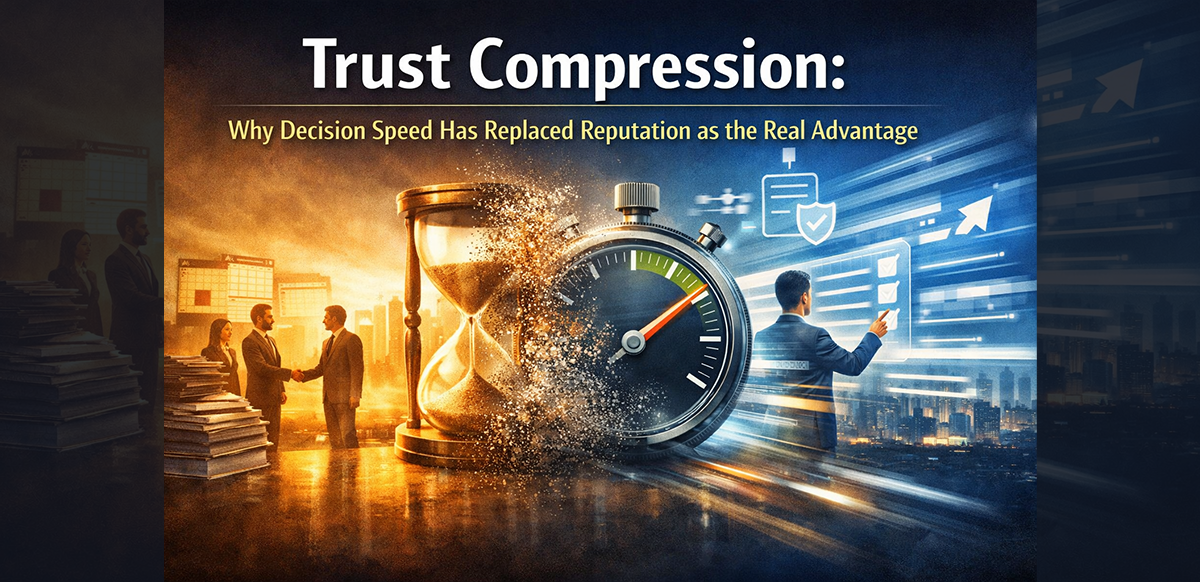
Trust compression reduces the time needed for buyers or clients to make decisions. In fast-moving markets, agents who communicate proof, clarity, and confidence quickly gain an advantage.
For decades, we were told the same story: “Build a good reputation. Trust takes time.”
That advice was correct—for a slower world. Today, it is a liability. In 2026, trust is still the currency, but time is the constraint. The advantage has moved from the accumulation of reputation to the velocity of trust formation.
The mechanism behind this shift is Trust Compression.
In the past, reputation functioned like a long-term asset. You deposited "good behavior" over years and withdrew "credibility" later.
This worked because:
The Problem: Reputation is backward-looking. It asks, "What has this person done?" In a fast market, your history is irrelevant if you cannot solve the client's current anxiety now.
Most professionals think trust means: “I believe you.” In high-stakes markets like property, modern trust means: “I no longer feel the need to keep evaluating.”
Trust Compression is the process of collapsing the evaluation window. The winner is not the most reputable person; it is the person who ends the client's decision-making torture the fastest.
Why Decision Speed is the New Moat:
Trust Compression does not rely on charisma or bonding. It relies on Architecture.
A. Predictability Beats Personality
People fear surprises and hidden friction. When a professional makes the process visible, sequenced, and "boring," anxiety collapses.
The Shift: Personality is variable; Protocols are stable. Predictability feels like safety.
B. Named Systems Outperform Credentials
Compare these two approaches:
Naming the system signals repeatability. It implies the result is independent of your mood or incentives. The client stops trusting you and starts trusting the mechanism.
C. Proof of Judgment over Proof of Success
Success creates skepticism; Judgment creates authority.
The Tactic: Show the deals you rejected, the mistakes you avoided, and the "good" options you flagged as "bad."
The Result: Explaining why a client should not buy something builds trust faster than showing 100 successful closings. It signals that you are an Advisor, not a Salesman.
Reputation is a "Page 1" problem—it takes years to get to the top. Trust Compression is an "Asymmetric" move. It allows a newcomer with a clear system to beat a veteran with a vague reputation. It allows a small, disciplined firm to outmaneuver a global agency.
Reputation asks: "Is this person good?"
Trust Compression answers: "Nothing bad will happen if I choose this now."
In high-stakes environments, the latter is a much more powerful driver of action.
In the context of ListingMine and the Super IP Network, Trust Compression is the "Product."
Traditional agencies fail because they rely on the unpredictable reputation of individual agents. Your Master Plan succeeds because it replaces "hustle" with Decision Architecture.
The question is no longer: “How do I build trust over time?”
The real question is: “What is creating hesitation, and how do I engineer a system to remove it instantly?”
The future belongs not to those who are trusted the most—but to those who make trusting them effortless.

Founder of ListingMine and author of Agent for Life. Building ERP for Malaysian real estate agencies since 2008 — and writing to reshape how agencies grow.
More about Marvin Foong →More articles in this topic