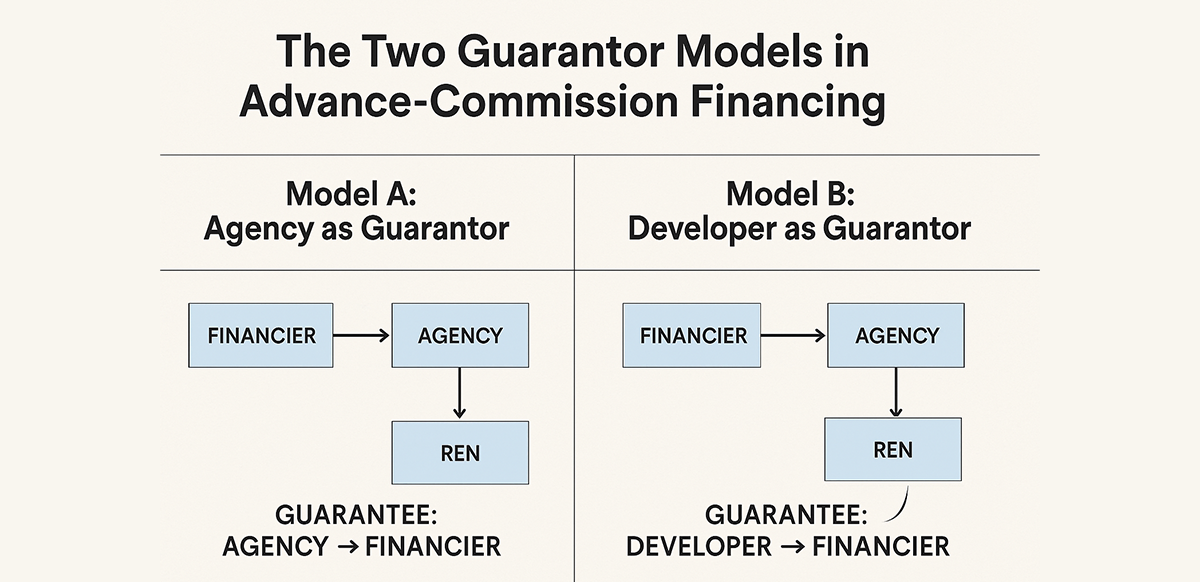
Advance-commission financing can use different guarantor structures to manage risk. Clear responsibility, repayment logic, and default protection are essential before money is released.
Why Malaysian Agencies Are Playing Bank — And Quietly Bleeding Out
Every advance commission in Malaysia is backed by a loan. Every loan is backed by a guarantor. Whoever signs that guarantee decides who survives and who collapses when the developer delays, restructures, or disappears.
There are only two possible guarantor models. One is used in 99% of cases and is financial suicide. The other is used in less than 1% of cases and is the only professional structure that actually protects agencies.
Let's dismantle this system once and for all.
(The "Suicide Pact" — The Industry Default)
This is how 99% of advance commissions work today.
REN closes a sale → requests an advance.
Agency approaches a financier (P2P platform, private credit, factoring firm).
Financier reviews SPA / loan docs → releases money.
Agency pays REN → issues PV + DN.
Agency signs as guarantor for the financing.
When (or if) the developer pays, the agency repays principal + interest.
That is the entire machine.
| Party | Risk Level | What Happens on Default |
|---|---|---|
| Financier | Near zero | Collects from the agency immediately |
| Developer | Zero | Pays nothing; faces no consequence |
| REN | Zero | Keeps the advance; rarely repayable in practice |
| Agency | 100% | Pays principal + interest + penalties out of its own pocket |
Imagine an agency advances RM3 million in a year. A mid-tier developer defaults on just 3% of units (very normal).
Loss = RM90,000 (plus interest + penalties).
To earn RM90,000 in real agency profit, you need roughly:
One bad developer can erase an entire year.
This isn't theoretical. This is happening right now to agencies you know.
Agencies tell themselves four convenient stories:
These are not strategies. These are false comforts whispered on the way to the financial graveyard.
(The Rare, Fair, Professionally Correct Model)
This is the model that should be standard — but only <1% of developers agree to it.
Under this system:
| Party | Risk Level | Outcome on Default |
|---|---|---|
| Financier | Moderate | Pursues the party with the land bank |
| Developer | 100% | Bears full responsibility |
| REN | Zero | Still receives advance |
| Agency | Near zero | No repayment obligation |
This is the only model aligned with logic and fairness. So why is it basically nonexistent?
(The Unfiltered Truth)
Here is the full, uncut list — including the real psychological reason:
This last point is the true heart of the system. Late commission is not an accident. It is deliberate leverage — and agencies have allowed themselves to be controlled by it.
Advance commission exists because developers refuse to pay on time — and agencies voluntarily become their unpaid bank.
| Annual Advances | 3% Default Rate | Agency Loss |
|---|---|---|
| RM2,000,000 | RM60,000 | RM60k |
| RM5,000,000 | RM150,000 | RM150k |
| RM10,000,000 | RM300,000 | RM300k |
A RM300,000 loss requires about RM100 million in property turnover to recover in real profit. No Malaysian agency has this buffer.
None.
For any serious agency in 2026 and beyond, there are only three rational positions:
Because once agencies collectively say: "No guarantee, no sales."
Developers will have only two choices:
Do this within the next seven days:
This is where change begins.
A developer who needs your balance sheet to pay their sales team is not a client. They are predators. Stop feeding them. Your agency's survival depends on it.

Founder of ListingMine and author of Agent for Life. Building ERP for Malaysian real estate agencies since 2008 — and writing to reshape how agencies grow.
More about Marvin Foong →More articles in this topic
This article is one of the sources behind this assessment. Take it to see what you already know and what to read next.
Educational self-assessment. Not a licensing examination or professional certification.