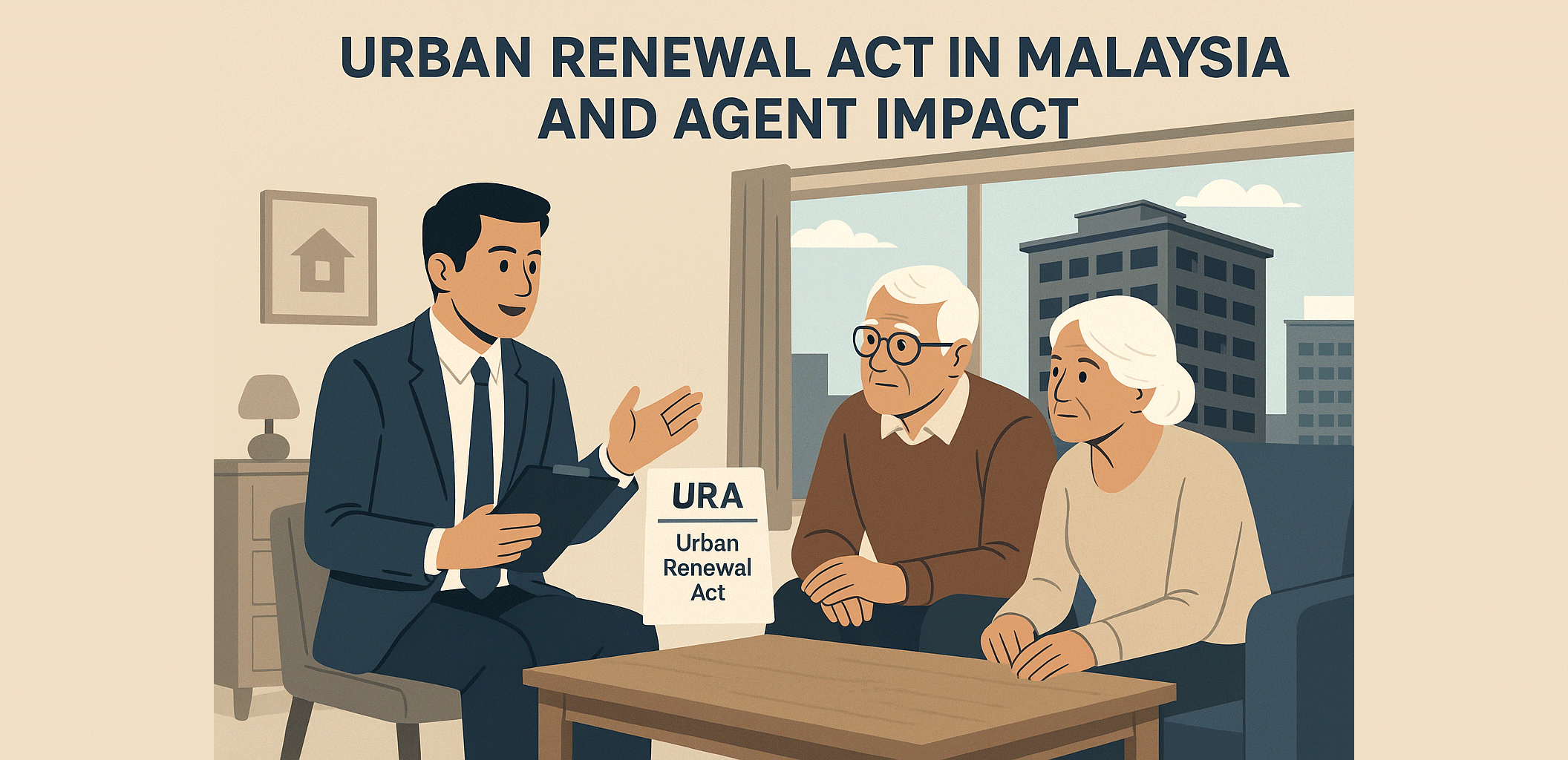
Urban renewal laws can affect owners, developers, redevelopment potential, and agent opportunities. Agents need to understand both benefits and risks of policy change.
A Landmark Law in the Making: What the URA Means for Owners, Market Risk, and Your Business.
The proposed Urban Renewal Act (URA) is a landmark legal framework designed to streamline and mandate the renewal, regeneration, or redevelopment of aging or underutilized urban properties in Malaysia.
Its primary goal is simple: to address buildings that are dilapidated, unsafe, or—most critically—stuck due to a lack of unanimous owner consent under the current Strata Titles Act 1985. The URA aims to kickstart investment, improve urban efficiency, and raise living standards in core city areas.
The most radical change is moving away from the difficult 100% owner consent requirement. The URA proposes tiered thresholds based on a building's age and condition:
This structure is intended to unblock stalled redevelopment projects, allowing the majority to proceed even if a minority of owners object.
While the intent to renew cities is sound, the proposed URA faces serious, multi-fold critiques concerning constitutional rights and financial fairness.
1. Property Rights vs. Compulsory Renewal
The move from 100% consent to 75% or 80% means that a majority (often developers collaborating with owners) can effectively impose renewal on dissenting minority owners. Critics argue this may conflict with the constitutional protection of property rights (Article 13).
2. Age Mismatch and Financial Anxiety
Many experts and condo owners argue that buildings 30-35 years old are not genuinely "old"; they often have 40-50 years of lifespan left with proper maintenance. Using a 30-year benchmark to trigger aggressive renewal creates financial anxiety for owners who still have long mortgage tenures or expected holding periods.
3. "Manufactured Consent" and Power Imbalance
A key concern raised by residents and NGOs is the risk of "manufactured consent." The process may heavily favour developers—who possess superior legal and financial resources—and disadvantage individual owners, especially those who are less informed or have lower incomes. There is a fear that consent could be obtained under pressure or without full transparency.
4. Lack of Safeguards for Compensation and Return
The current Bill is criticized for lacking detailed guarantee clauses for vulnerable stakeholders, including:
Without these safeguards, critics warn of potential gentrification, displacement of original residents, and worsening social inequality.
If the URA is passed, it will fundamentally influence inventory, valuation, and client advisory in older urban estates. Agents must move from being passive salespeople to being active, informed advisors.
The URA signals a structural and behavioral shift in the Malaysian property market. For agents, the best strategy is not to react to the regulation, but to stay ahead of it.
Top-performing agents don't just sell properties; they interpret frameworks, protect clients, and unlock latent value within a complex legal environment. Use the URA context to add essential value: help owners navigate consent, risk, and strategy—don't just run a listing.

Founder of ListingMine and author of Agent for Life. Building ERP for Malaysian real estate agencies since 2008 — and writing to reshape how agencies grow.
More about Marvin Foong →More articles in this topic
This article is one of the sources behind this assessment. Take it to see what you already know and what to read next.
Educational self-assessment. Not a licensing examination or professional certification.