Scalable agencies need values that work across teams, locations, and market cycles. Practical values must translate into rules, systems, and daily behaviour.
In Malaysia's property industry, value stances are often seen as "nice-to-haves" for corporate social responsibility. This is a mistake. In a small, high-feedback ecosystem, value stances are market survival positions.
In Malaysia, buyers and sellers do not trust institutions by default; they observe outcomes. Platforms that prioritize consumer protection—by reducing misinformation and enforcing accountability—become legitimate even if they are initially unpopular with the "old guard." Reach is easy to buy; legitimacy is hard to earn, but it compounds much faster.
The industry has normalized disposability: agents are treated as replaceable units, and their effort is rarely documented. Professionals choose dignity over hype. Platforms that clarify rules and protect individual contributions attract the best long-term participants. When you respect the provider, you stabilize the supply.
In small markets, gatekeepers (information hoarders and discretionary approvers) become bottlenecks. Systems that decentralize power through audit trails and transparent workflows create structural resilience. Gatekeeper-dependent systems feel efficient in the short term, but they are fragile—they collapse the moment the gatekeeper leaves or pivots.
Data hostage-taking is uniquely destructive in Malaysia because mobility is high and retaliation is often quiet. Retaining agents through fear or data-locking never works long-term. Platforms that treat data as governed infrastructure—shared memory rather than a weapon—outlast those that use it for control.
Strategy in Malaysia must account for the "Privacy of Reputation."
Everyone Knows Everyone: Reputation is social. Bad behavior doesn't always go viral; it goes private. It is whispered in WhatsApp groups and over coffee. Private distrust is harder to fight than public criticism.
Hypocrisy is Punished Silently: In Malaysia, people rarely confront a platform or agency publicly. They simply disengage. You don't get boycotted; you get ignored. Recovery from irrelevance in a small market is almost impossible.
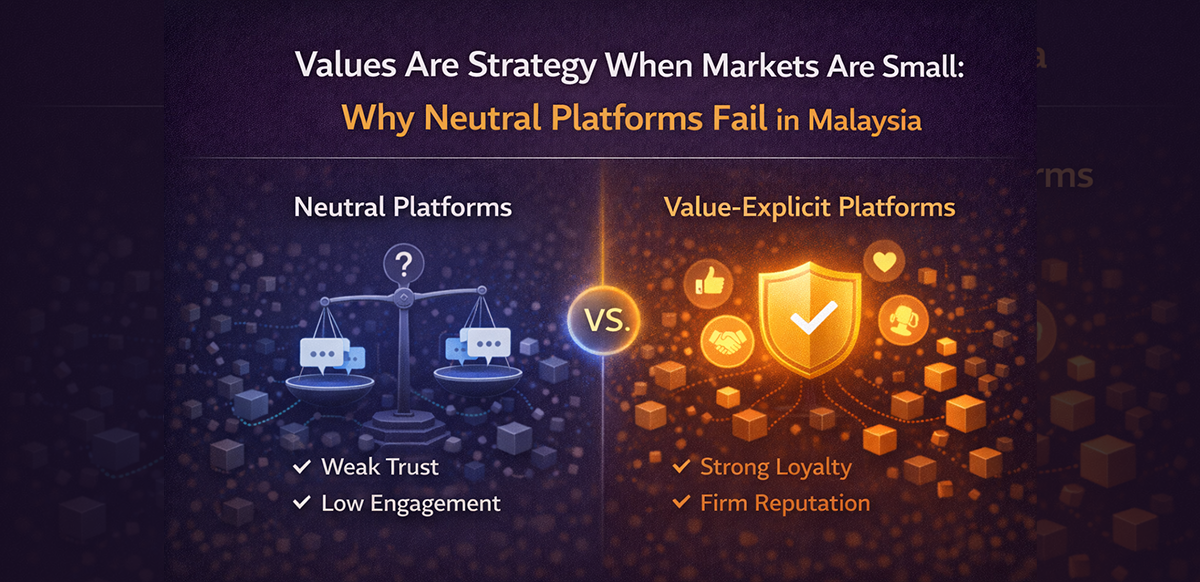
Many platforms try to remain "neutral" to protect short-term volume. In Malaysia, this is a trap. Neutrality protects the lowest common denominator of behavior, which inevitably repels:
Losing these people is fatal. Neutral platforms grow fast and hollow out just as quickly.
Value-explicit platforms face resistance early and grow slower at the start because they attract fewer users. However, they:
In a small market, loyalty beats liquidity.
Malaysia does not need louder platforms; it needs platforms with the courage to define who they are for and what they will not tolerate. In large markets, values are optional. In Malaysia, values are the strategy.
Neutrality is the easy path to mediocrity. Commitment is the hard path to dominance. Only one survives the transition to a mature market.

Founder of ListingMine and author of Agent for Life. Building ERP for Malaysian real estate agencies since 2008 — and writing to reshape how agencies grow.
More about Marvin Foong →More articles in this topic