Innovative platforms fail when culture, adoption habits, and user behaviour do not support the product. Real estate innovation must fit daily workflow, not only look futuristic.
ListingMine Academy | Platform Strategy & Venture Architecture
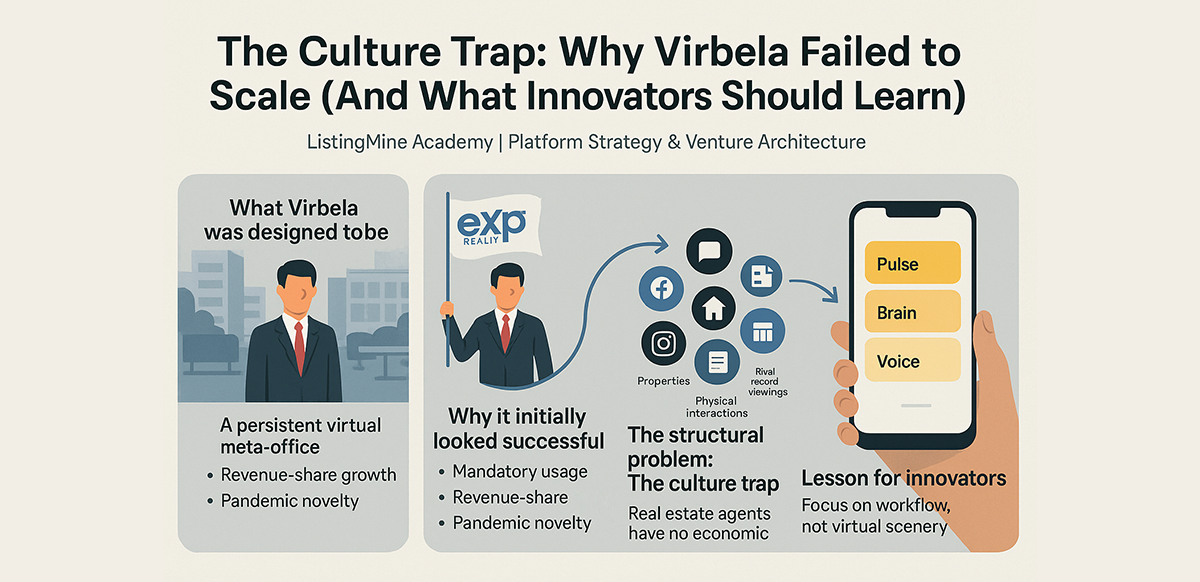
Virbela was once positioned as the future of remote real estate operations — a metaverse-style virtual campus where agents could work, meet, learn, and collaborate. Powered by eXp Realty’s explosive growth, it appeared to be a new category altogether: a full digital office that eliminated branches, reduced overhead, and united a global workforce through avatars.
For a moment, it looked like the future.
But as the hype faded, Virbela struggled to gain traction outside eXp.
Adoption stagnated.
Usage dropped.
The broader market simply did not follow.
The failure wasn’t technological. It was psychological, behavioural, and economic.
To build the next generation of real estate platforms, founders must understand why Virbela stalled — and how to avoid repeating the same trap.
Virbela attempted to create a persistent virtual workspace — a digital world designed to replace the physical office. It came with virtual campuses, avatar-based meetings, digital auditoriums, virtual training halls, office “zones,” private rooms, and simulated collaboration areas.
In the early 2010s, this was visionary. During the pandemic, it felt inevitable.
But once normalcy returned, the cracks became obvious.
Virbela’s early traction was not organic — it was structural.
eXp Realty required every agent to use Virbela, creating a captive user base that made the platform appear more popular than it truly was.
At the same time, eXp’s rapid recruitment growth pushed more people into Virbela, giving the illusion of product adoption when in reality it was tied to hiring, not preference.
Pandemic tailwinds further boosted usage across all virtual tools, and Virbela benefited from that momentum.
Finally, the novelty of avatars, virtual meeting halls, and digital campuses generated curiosity. But novelty does not guarantee long-term retention.
Virbela’s biggest weakness was not its technology — it was the mismatch between how agents work and what Virbela demanded from them.
It asked users to behave like gamers. Agents are not gamers.
And the biggest mismatch of all: Virbela simulated an office environment, but did not connect to the actual economy of real estate.
The most fatal flaw was economic: there are no buyers inside Virbela.
Real estate agents follow demand. They go where buyers are:
But in a virtual campus?
No buyers → no leads → no income.
That alone kills adoption. A tool that generates zero revenue opportunity will always be ignored, no matter how innovative it looks. Once agents realized Virbela produced no business, usage collapsed.
If agents wanted to explore virtual worlds, they already have more polished options:
These platforms offer high-level graphics, smooth movement, strong engagement loops, and instant onboarding. Virbela offered:
It became a strange hybrid: a game that isn’t fun, and a work tool that isn’t productive.
Agents quickly labelled it: “A low-quality RPG game where nothing valuable happens.”
That perception alone is enough to kill any platform.
Even before entering the campus, Virbela created friction. Agents had to:
Just to attend a meeting. Meanwhile, Zoom or WhatsApp offered one-tap simplicity. When the effort-to-reward ratio is this poor, abandonment is inevitable.
Real estate operations rely on:
Virbela improved none of these. It improved where people met, not how the work happens. But improving the environment does not change the economics of real estate.
Beyond eXp, almost no companies adopted Virbela.
The reasons were obvious:
The moment eXp’s recruitment slowed, Virbela’s growth flatlined. It was never a true platform — it was a corporate tool. And corporate tools rarely scale into independent ecosystems.
Structurally, Virbela struggled because:
A platform cannot grow if its entire user base is tied to a single organisation’s internal operations.
Here is the nuance: We cannot say “never build a metaverse.”
Technological evolution is rapid. AI-driven presence, AR/VR hardware, and even neuro-tech (Neuralink) may change how humans work and interact. Younger generations already live comfortably inside digital spaces.
A future form of the workplace may indeed be immersive. So the lesson is not “don’t build it.”
The real lesson is this: If you build it, you must solve for adoption, friction, distribution, and economic incentives — not just immersion.
Solve a painful, revenue-linked problem
Real estate tools succeed when they:
Aesthetics alone never justify adoption.
Remove friction ruthlessly
Next-generation environments must be:
Ease of entry is non-negotiable.
Create economic gravity
If your environment does not contain buyers, listings, or dealflow, agents will never stay inside it.
Work platforms require economic participation, not digital scenery.
Build micro-experiences before macro-worlds
Start with:
Let usage create the world — not vision alone.
Build a distribution engine
The best product idea dies without:
Virbela looked futuristic, but futurism is not a distribution strategy.
Not because the metaverse is impossible. Not because agents hate tech. Not because virtual worlds cannot work. Virbela failed because:
The future may absolutely involve virtual presence, immersive workspaces, and neural-linked collaboration. But those platforms will succeed only when:
Innovation is not about the metaverse. Innovation is about building something people choose to use — because the value is so obvious they can ignore everything else.

Founder of ListingMine and author of Agent for Life. Building ERP for Malaysian real estate agencies since 2008 — and writing to reshape how agencies grow.
More about Marvin Foong →More articles in this topic