A franchise may look failed under one lens but successful under another if it creates brand reach, recruitment, or market presence. The real question is whether the model produces sustainable economics.
Why Malaysia's largest agencies believe this (and are right)—and why the model that made them successful is about to become their biggest liability.
Malaysia’s biggest real-estate agencies are proud — and rightfully so. They’ve built empires out of chaos, turning loose armies of agents into disciplined machines.
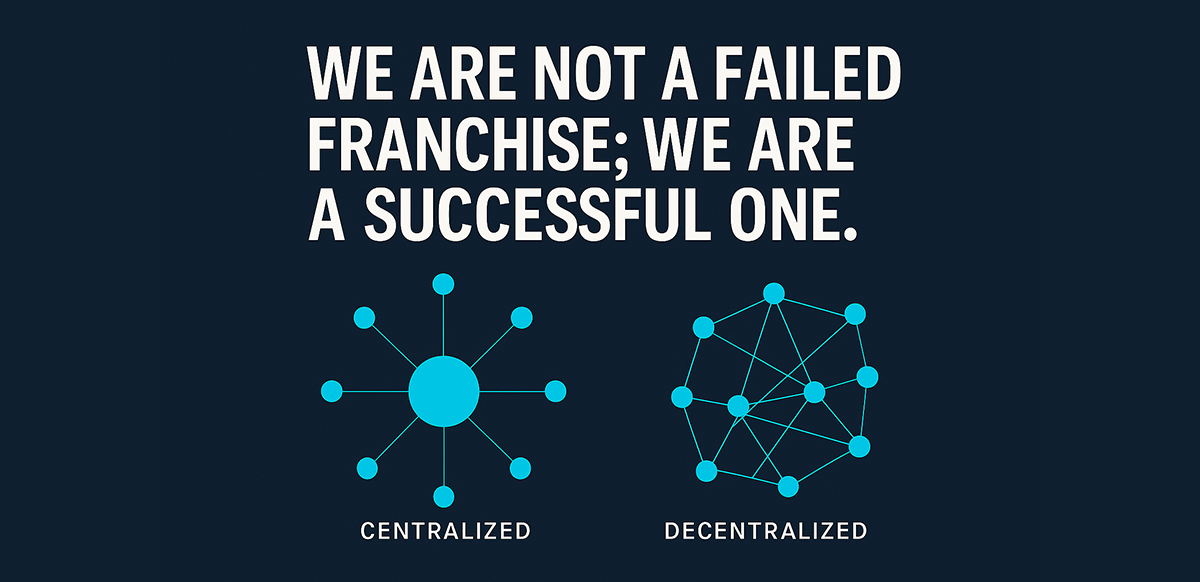
“We are not a failed franchise; we are a successful one.”
And they are 100% correct.
They are successful because they solved the industry's biggest problem: chaos. They built a system that tamed it.
But the very thing that made them successful—their powerful, centralized model—is now their single greatest vulnerability. The system that protected them is becoming a prison.
The leaders of these firms are not running a "franchise" in the old 1980s sense. They are running a far more sophisticated model: The Centralized Bundle.
For decades, the average agent was lost in chaos. The "super-agencies" offered a compelling deal: "Join us. In exchange for your overrides and fees, we will take on all the complexity."
This "bundle" was incredibly valuable:
| The Problem | The "Super-Agency" Solution |
|---|---|
| Chaos | Built proprietary CRMs and ERPs to organize agents. |
| Risk | Hired legal and AMLA teams to protect thousands. |
| Brand | Created national brands consumers trust. |
| Career Path | Trained new RENs into team leaders. |
They didn’t just sell houses; they sold certainty. This is the model that defined the last decade of Malaysian real estate.
But the bigger the bundle, the heavier it becomes. What once bought loyalty now breeds friction.
This "bundle" is incredibly heavy. It is operationally and financially expensive to maintain. And the cost of that bundle, once their greatest asset, has now become their greatest liability.
This liability is threefold:
To provide this "bundle," you must have massive, centralized overhead.
You must have a multi-million Ringgit tech budget, a huge corporate HQ, large administrative staff, and expensive legal teams. This forces you to rely on high overrides and fees just to pay for the central infrastructure. This is the "economic misfit."
To protect the "bundle," you must have centralized control.
You must control the brand, the marketing, and the commission structures to ensure uniformity. This is the "speed limiter" that frustrates your best people. More importantly, it creates an inevitable glass ceiling.
What happens when your top team leader becomes a superstar? They look at the overrides they're paying and the brand restrictions they're under, and they realize their only path to 100% freedom is to leave. The super-agency model cannot retain its most successful graduates.
Their tech, which was once their biggest selling point, is now their biggest anchor.
Their proprietary systems are "Walled Gardens." They are "mainframe computers" in an era of cloud computing. They are slow, expensive to update, and—most critically—they do not talk to other systems. They were built to lock agents in, not to connect them out.
The "successful franchise" model is a powerful, centralized mainframe. It is about to be made obsolete by a flexible, decentralized network.
This is the "Alliance ACN" (Agent Collaboration Network) model. It's the "cloud" that's coming for their "mainframe." This new model attacks their "bundle" by "unbundling" it—offering every agent all the benefits with none of the costs.
| The "Successful Franchise" Bundle | The "Alliance ACN" Unbundle |
|---|---|
| "Our Brand is the trust." | "The System Proof is the trust." |
| "Our Proprietary Tech" (A Walled Garden) | "Your Private ERP" (A Sovereign System that can connect) |
| "Our Centralized Compliance" (Heavy, Manual) | "Compliance-by-Design" (Light, Automated) |
| "Our Override Model" (You pay up to us) | "The Mentor Model" (You "graduate" agents and earn with them) |
Picture this: A 20-person agency in Penang runs on a modern, connected ERP. It automates compliance, connects co-broking partners, and pays commissions instantly. Their cost base is 90% lighter — yet their system power equals a national franchise.
This new model is a lethal competitor. It gives agents all the benefits of the "bundle" (system, compliance) without forcing them to pay the price (overrides, brand surrender).
The leaders of Malaysia's super-agencies are right. They are not "failed franchises." They are incredibly successful.
They were masters of centralization in an era that demanded it.
But the game has changed. The new era will be defined by decentralization, proof, and interoperability.
Their success isn't a lie—it's just an operating model that has expired. The very "bundle" that made them rich and powerful is now too heavy, too slow, and too expensive to compete with the light, fast, and flexible networks of the future.
Their greatest success is now their biggest liability.
Centralization was the language of survival.
Interoperability will be the language of dominance.

Founder of ListingMine and author of Agent for Life. Building ERP for Malaysian real estate agencies since 2008 — and writing to reshape how agencies grow.
More about Marvin Foong →More articles in this topic