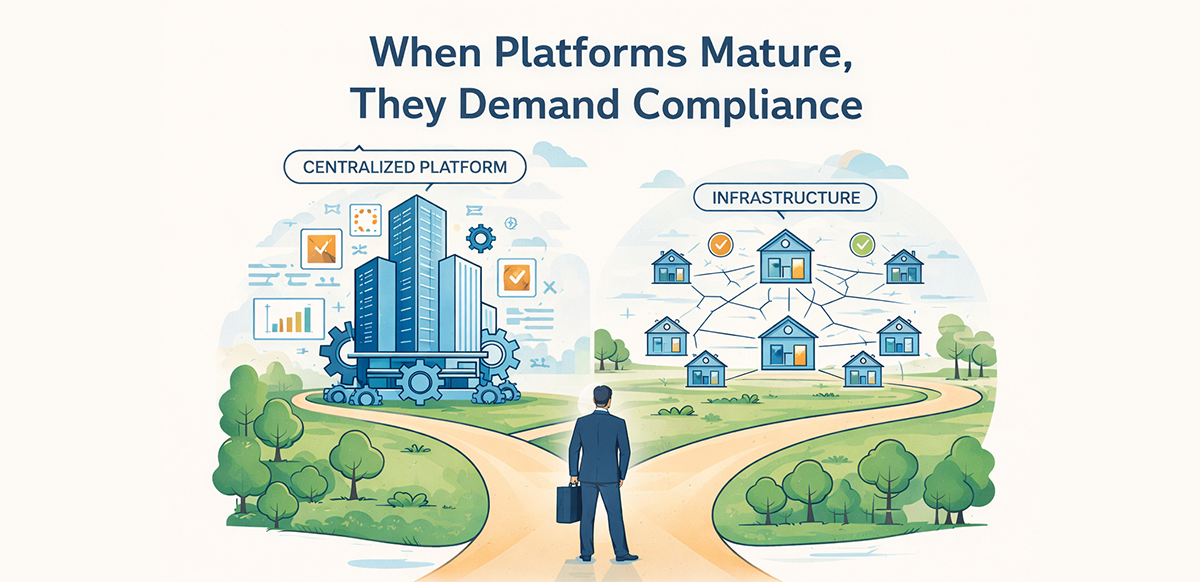
Mature platforms eventually require stronger compliance, data discipline, verification, and governance. Growth forces informal participants to become more structured.
In the early stage of any platform, leadership is oxygen. Growth requires independent builders who bring networks, conviction, and local authority.
Platforms at this stage are fragile. They need strong personalities to expand reach, recruit talent, and establish legitimacy. Vision matters more than uniformity, and entrepreneurial leaders are treated as strategic assets.
However, once a platform reaches sufficient scale, the internal logic changes.
Stability becomes more valuable than experimentation. Efficiency becomes more important than autonomy. Governance replaces improvisation.
At maturity, the platform no longer depends on distributed leadership. It depends on predictable execution.
Leadership becomes optional. Compliance becomes essential.
This is not a moral statement. It is structural economics.
Beike in China offers a powerful case study of this evolution.
In its growth phase, the platform expanded by integrating independent agencies and team leaders into its network. These leaders brought listings, agents, and local market density.
The platform’s expansion relied on entrepreneurial energy and regional influence.
In that stage, independent leaders were indispensable. They were not merely participants; they were growth engines.
But once scale was achieved, the center strengthened.
As the network matured, uniformity created margin protection. Variability became operational risk.
The platform itself became the infrastructure.
When the system grows powerful enough, it does not need leaders in the same way. It needs disciplined operators who execute within predefined architecture.
Layers that were once strategic become cost centers. Redundancy is reduced. Efficiency dominates.
This is the natural gravity of maturity.
When a centralized system matures, economic gravity consolidates inward.
Data resides at the center. Process authority resides at the center. Brand power resides at the center.
The platform becomes the source of legitimacy rather than the individuals operating within it.
For early contributors, this creates a silent shift.
They once expanded the platform. Now the platform defines them. Their autonomy narrows as system protocols expand. Their leverage decreases as standardization increases.
This is not betrayal. It is optimization.
Mature systems reduce variability. Independent leaders are variable by nature.
Eventually, the central question changes:
At that point, compliance becomes structural currency.
Malaysia does not yet have a Beike-scale centralized platform. The property market remains fragmented.
Team leaders still hold meaningful influence. Agencies still depend on personality and local networks. Mobility remains high, and structural fluidity defines the ecosystem.
However, digital coordination is accelerating.
The same economic laws that shaped larger markets will eventually shape Malaysia.
When scale increases, consolidation pressures follow.
The critical question for Malaysian team leaders is not whether centralization is good or bad. It is whether their long-term position inside such a system remains structurally secure.
If you are building entirely inside a centralized architecture, your growth strengthens the center.
When maturity arrives, the center protects itself first.
The individuals who built the platform may find that the platform no longer requires them in the same way.
There is another way to scale coordination: infrastructure without absorption.
When software functions as a business, it accumulates gravity. Participation strengthens the center. As maturity increases, compliance becomes the stabilizing mechanism.
Leadership dissolves into system design.
When software functions as infrastructure, it distributes gravity.
Infrastructure enables coordination while preserving independence.
Leaders operate on the rails rather than being absorbed by them.
Infrastructure does not eliminate leadership at scale. It preserves it.
In a high-mobility market like Malaysia:
Distributed infrastructure aligns more closely with this reality.
Portability matters. Data continuity matters. Structural sovereignty matters.
Centralized platforms prioritize system protection. Infrastructure prioritizes participant durability.
As platforms mature, they do not require philosophical dissent. They require disciplined execution.
For many professionals, this is acceptable.
But not every leader seeks to become an interchangeable component within a machine.
Some seek architectural agency.
They want:
Malaysia may not yet have a dominant centralized giant. But maturity is not a question of if; it is a question of when.
The structural choice made today determines future autonomy.
It will determine whether future leaders remain:
Platforms grow by absorbing leaders.
Infrastructure grows by enabling them.
When scale arrives, the difference becomes irreversible.

Founder of ListingMine and author of Agent for Life. Building ERP for Malaysian real estate agencies since 2008 — and writing to reshape how agencies grow.
More about Marvin Foong →More articles in this topic