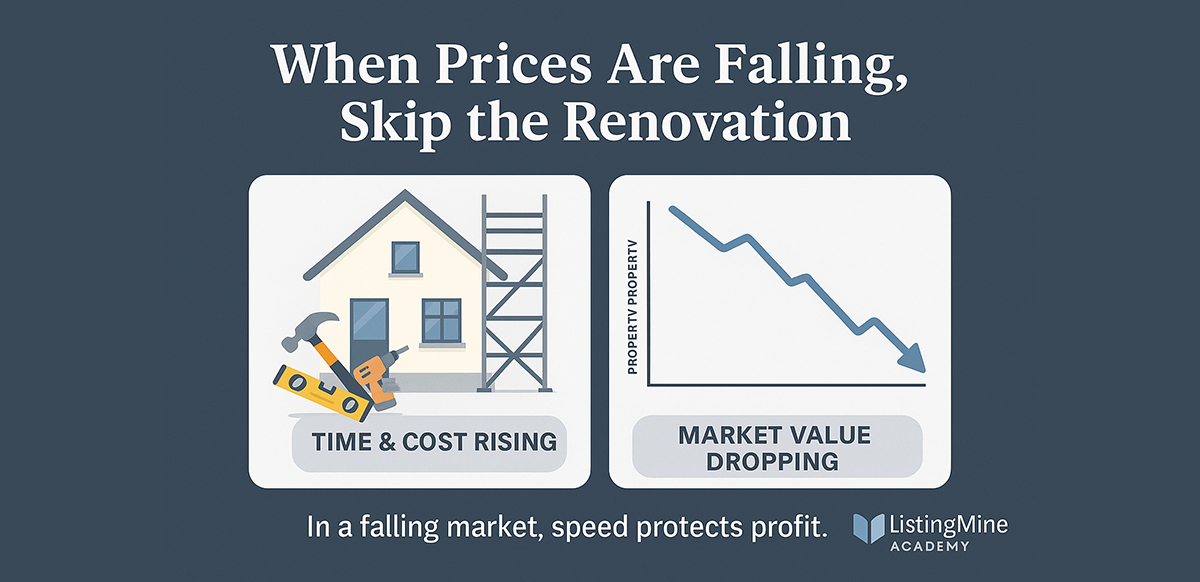
Renovate-then-sell becomes dangerous in a falling market because holding cost, renovation cost, and lower resale prices can destroy margin. Agents and owners need market timing discipline.
When property prices are rising, renovating before selling can make perfect sense. A fresh coat of paint, new kitchen cabinets, or upgraded flooring can create emotional appeal and help you command a premium.
But when the market is falling — and prices are dropping fast — that same strategy can quietly destroy your profit. Here’s why.
Renovation takes time. Even a “light touch” makeover can stretch from two to six months, once you factor in:
In a fast-declining market, that time lag can be fatal.
By the time you’ve finished your renovations, the market value may have already dropped by 5–10%, wiping out not just your renovation cost, but also your expected profit margin.
In a falling market, time is not your friend — it’s your biggest expense.
Renovation costs rarely go down. Material prices, contractor labor, and finishing works are sticky and often rise even during downturns due to inflation or supply issues.
That means you’re injecting fixed cash into a depreciating asset. Even if your unit looks more beautiful than others, the market won’t care if buyers can now find a similar property RM50,000 cheaper down the street.
You’ve improved the unit — but you can’t out-renovate a price slide.
In a falling market, buyers get smarter and more cautious. They compare every available unit and start discounting emotionally — not rewarding effort.
A fully renovated unit may help it sell faster, but it won’t necessarily sell higher. Buyers will say, “Nice unit — but the market rate now is lower.” Your extra RM30,000 in tiles and fixtures simply becomes their bargain.
When prices are dropping, speed of exit becomes the real profit protector. The longer you hold, the more value you lose. Instead of renovating, your goal should be to price aggressively and exit early, even if it means selling slightly below yesterday’s peak.
Renovation may make you feel productive, but in a downtrend, liquidity is the only renovation your balance sheet needs.
In a down market, the smart strategy isn’t to chase premium buyers — it’s to protect capital.
You can still do small, fast-impact fixes that improve presentation without time risk, such as:
These low-cost, high-visibility actions keep your listing competitive — without the multi-month exposure risk of a full renovation.
In a falling market, every week you delay is a hidden discount to your eventual sale price. Renovate-then-sell works only when appreciation outruns your renovation cost and timeline — not when values are sliding.
If prices are dropping fast, skip the renovation. Sell early, preserve liquidity, and let the next buyer do the makeover.
In a falling market, survival beats style — because capital preserved today becomes opportunity tomorrow.

Founder of ListingMine and author of Agent for Life. Building ERP for Malaysian real estate agencies since 2008 — and writing to reshape how agencies grow.
More about Marvin Foong →More articles in this topic
This article is one of the sources behind this assessment. Take it to see what you already know and what to read next.
Educational self-assessment. Not a licensing examination or professional certification.