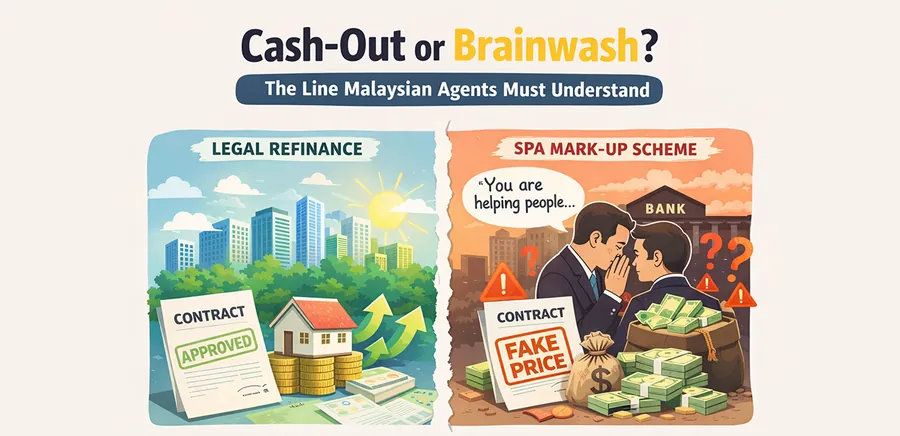
Some cash-out practices appear professional on the surface but may involve legal or ethical problems. Agents need to understand where financing creativity becomes abuse.
Some agencies look highly professional from the outside. They speak confidently about compliance. They use polished language and corporate branding. They present themselves as structured, sophisticated, and credible.
But behind that façade, a growing number of agencies quietly specialise in one thing: Aggressive—and often illegal—cash-out transactions.
This is no longer fringe behaviour. It has evolved into a niche business model, sustained not by legality, but by the absence of real consequences.
In Malaysia’s current property transaction system, there is effectively only one gatekeeper: The Bank. The process usually looks like this:
An agency proposes a transaction structure.
Documents are prepared.
A loan application is submitted.
If the bank approves, the deal proceeds. If the bank rejects, the deal stops. And that is where the story ends.
There is:
This creates a dangerous incentive imbalance. For agencies engaging in questionable cash-out practices, the downside is almost zero.
The worst-case scenario is simple: The bank rejects the loan. That’s it. No penalty. No disciplinary action. No reputational damage.
The Economic Asymmetry:
Cost to try: Zero.
Reward if successful: High commission, faster closure, “hero” status with the client.
Penalty if rejected: None—simply submit to another bank.
In such an environment, unethical behaviour is not reckless. It is economically rational.
A common misconception is that sellers are promised above-market prices. In reality, the opposite is usually true. Most sellers involved in these schemes are not greedy. They are desperate.
They are facing loan default, divorce, migration, or business failure. They need speed and certainty. They are willing to accept below market value in exchange for a quick exit.
A Realistic Scenario:
True Market Value: RM500,000.
Seller's Bottom Line: RM450,000 (for a fast sale).
Agent A (Honest): “We should market this at RM500,000. It may take time, but it’s clean and legal.”
Agent B (Unethical): “I already have a buyer. But they can only proceed if the price is RM450,000. We can close quickly.”
The seller is not choosing ethics. They are choosing certainty. RM450,000 today feels safer than RM500,000 "someday." So the seller agrees.
The illegality does not happen during negotiation. It happens at documentation. Specifically, Multiple Sale & Purchase Agreements (SPAs) are produced.
SPA 1 (Internal): Reflects the true agreed price (RM450,000).
SPA 2 (Submitted): Reflects an inflated price (e.g., RM600,000).
The inflated SPA is stamped and selectively presented to the bank-appointed valuer.
Most residential valuations rely on the Comparable Method. The vulnerability lies in data timing. Official transaction data from JPPH is inherently lagged, typically by 3–6 months.
Because of this lag, valuers must rely on recent evidence supplied during valuation. Stamped SPAs with inflated prices exploit this gap by acting as false “recent comparables.” To the valuer:
The valuation is anchored to a false recency signal—not because the valuer is careless, but because the input data was deliberately corrupted.
Once the transaction completes, the inflated price (RM600,000) does not disappear. It becomes officially recorded.
Six months later, a legitimate valuer checks transaction history and sees: "This house sold for RM600,000." They did not know it was a cash-out scheme. They assume it was a willing buyer and a willing seller.
The Self-Reinforcing Distortion:
The unethical agent didn't just cheat one deal. They corrupted the valuation baseline for everyone else.
The unethical agent does not usually “win” the listing from the honest agent. In many cases, there is no exclusive appointment at all. The difference is simpler—and more dangerous: One agent has a buyer. The other does not.
Agent A (Honest): Prices correctly, waits for genuine demand, refuses to manipulate documents.
Agent B (Unethical): Already has a buyer prepared to do a cash-out structure.
The honest agent "loses" the deal without doing anything wrong. This is how honesty becomes slower, harder, and less competitive—not due to lack of skill, but due to an enforcement gap.
An industry cannot mature while quietly tolerating illegal niches. Cash-out abuse does not make agencies smarter. It makes the profession weaker.
When the worst possible outcome is “the bank said no,” misconduct will continue to hide behind professionalism. Until real consequences exist upstream, the façade will remain—and the industry’s own data will continue to lie.

Founder of ListingMine and author of Agent for Life. Building ERP for Malaysian real estate agencies since 2008 — and writing to reshape how agencies grow.
More about Marvin Foong →More articles in this topic
This article is one of the sources behind these assessments. Take one to see what you already know and what to read next.
Educational self-assessment. Not a licensing examination or professional certification.