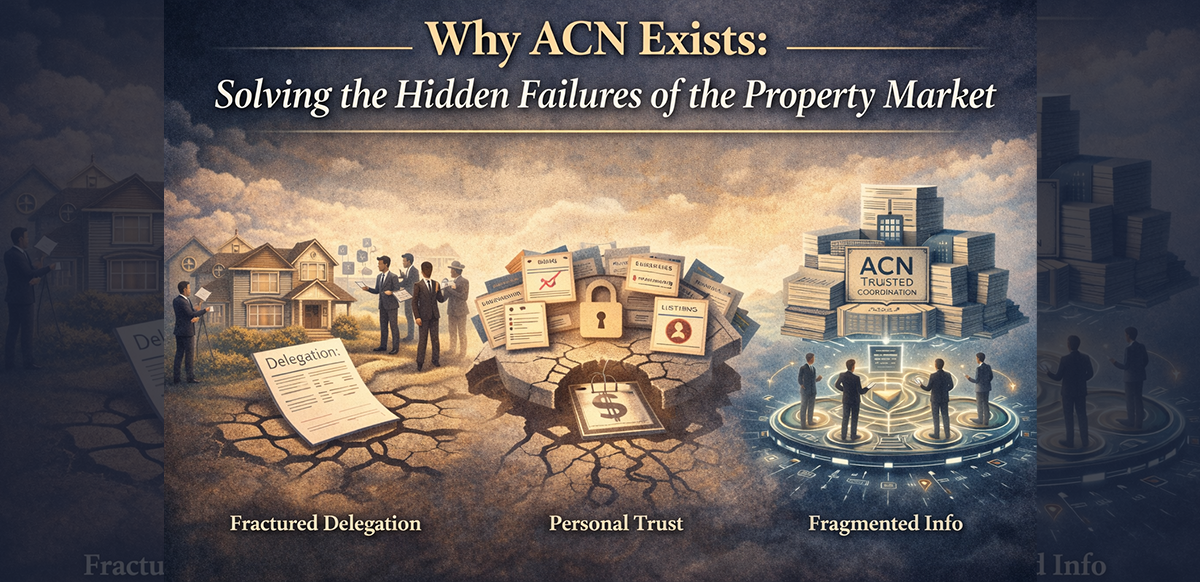
ACN exists to solve hidden failures in trust, role recognition, buyer-seller matching, and commission fairness. It formalizes cooperation where the market is fragmented.
At first glance, the property market looks busy and competitive. Agents chase listings, sellers are contacted repeatedly, and properties flood every portal. Activity is high. Efficiency is not.
Beneath this surface intensity lies a set of structural failures that quietly drain value from the entire system. Most agents believe their main challenge is "selling better." In reality, the hardest problems occur before any selling begins.
These failures fall into three critical categories.
A seller wants to sell one property. Because there is no trusted coordination layer, multiple agents independently attempt to secure the same delegation. Each repeats the same actions: searching for the owner, making calls, visiting the property, and taking photos.
The Result: Work is repeated not to create value, but because no one can rely on work done by others. Delegation becomes a zero-sum contest rather than a stable foundation. Energy is spent competing for permission, not executing on value.
Most trust in property transactions is interpersonal: "I trust this agent; I don't trust listings I didn't source." When trust is personal, information is hoarded and verification is endlessly repeated.
The Result: A hidden Trust Tax—massive amounts of time, money, and emotional energy spent redoing work that already exists. This tax is paid by agents and sellers alike.
A physical house cannot move through the market; only its information can. But in today's system, descriptions of conflict and media quality vary.
The Result: The same property appears multiple times with different narratives and prices. Liquidity suffers—not because demand is absent, but because information cannot be trusted.
ACN is not a social agreement or a culture change initiative. It is a coordination system designed to fix these failures without relying on goodwill.
In an ACN, delegation is recorded, scoped, and verifiable. Once a seller appoints an agent, authority is documented and the work performed—the photos, the data, the documentation—becomes reusable infrastructure.
The Shift: Delegation stops being a contest and becomes industry-wide plumbing.
Instead of asking agents to "trust each other," ACN enforces trust through structure. Listings are verified once; media is produced once; terms are recorded once.
The Shift: Trust no longer depends on who you know, but on what the system can verify.
Under ACN, information is no longer defensive or disposable. High-fidelity listings have provenance, timestamps, and accountability. Instead of ten weak descriptions competing, one strong description compounds across the network. Information becomes leverage, not liability.
ACN allows agents to specialise without losing control:
The property market's problems are not caused by lazy agents or weak sales skills. They are caused by coordination failure.
ACN fixes coordination by providing:
When a system is designed correctly, cooperation becomes the most profitable strategy for every participant. ACN works because it makes coordination more efficient than competition.

Founder of ListingMine and author of Agent for Life. Building ERP for Malaysian real estate agencies since 2008 — and writing to reshape how agencies grow.
More about Marvin Foong →More articles in this topic