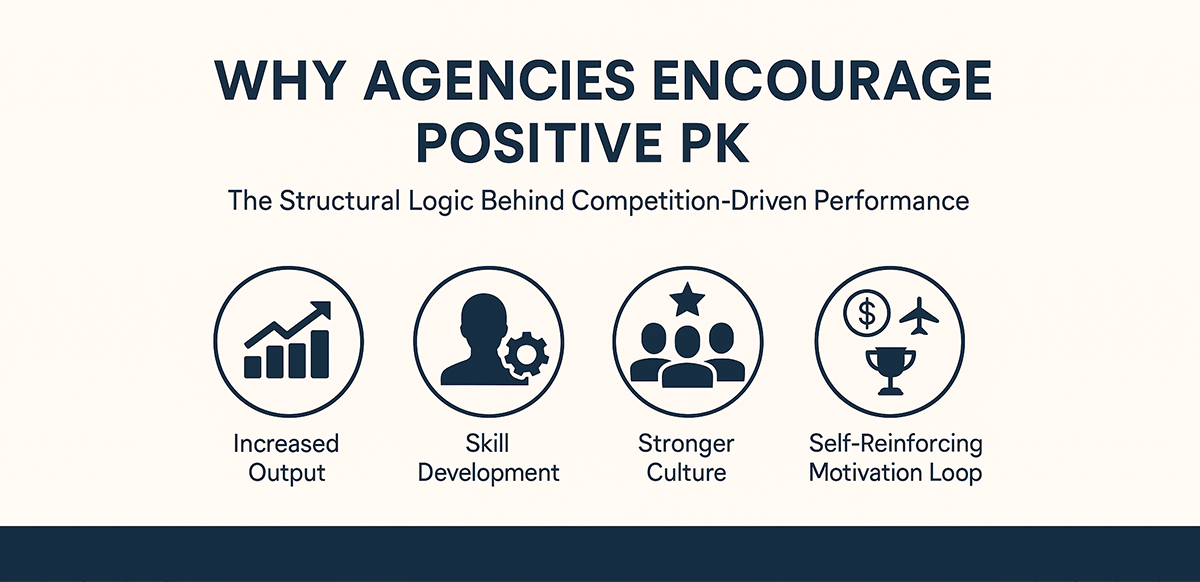
Positive PK creates internal comparison that can motivate agents when handled properly. Agencies use performance competition to build energy, but it must avoid unhealthy pressure and politics.
In Malaysian real estate, "PK" has quietly evolved from its gaming roots into a practical management tool — a structured, time-bound competition designed to increase agent output, sharpen skills, and elevate agency performance.
At ListingMine Academy, we examine PK not as a motivational gimmick, but as an economic mechanism. Properly engineered, Positive PK converts human competitiveness into predictable agency revenue, without needing additional manpower or costly incentives.
This is a model every principal and team leader should understand.
Most agents possess ambition, but ambition without structure produces inconsistency.
Positive PK introduces:
This alone changes behaviour.
During PK cycles, agencies routinely observe:
This is not a coincidence. PK converts latent competitiveness into visible production. While training increases capability, PK increases activity volume, which is the single strongest predictor of revenue in agency economics.
Real estate lacks natural pressure:
PK solves this structural weakness by creating manufactured urgency:
Agents behave differently when there is a clock, an opponent, and a prize. PK transforms a passive workflow into an active campaign.
PK is not merely about working harder; it's about working better.
Competition forces:
Pressure compresses learning. A single PK cycle can achieve what 3–6 months of normal operations cannot. Because PK winners become internal case studies, their tactics are quickly duplicated across the agency. This creates collective capability uplift, not just individual improvement.
One of the hidden values of PK is that it serves as an organizational diagnostic system.
Within a single cycle, principals can identify:
PK surfaces truth. This is strategically important for agencies planning team expansion, overrides, or role specialization.
Agents resist being pushed by a boss.
But they react immediately when:
Peer pressure drives higher and more sustainable performance than top-down pressure. PK leverages this psychological truth. It is a form of self-enforcing discipline, reducing the need for micro-management.
Poorly designed contests produce chaos. Well-designed Positive PK produces precision.
Instead of random aggression, PK forces agents to:
PK reframes obstacles as targets to eliminate, not problems to complain about. This shift in mental model is central to high-performing agency culture.
Agencies don't give rewards randomly. Each is a psychological instrument.
| Reward Type | Strategic Benefit |
|---|---|
| Cash | Immediate reinforcement. Links performance to tangible lifestyle improvement. |
| Travel | Status, experience, memory. Builds aspiration and prevents burnout. |
| Trophies & Recognition | Identity and internal branding. Creates role models for new recruits. |
Together, these rewards create a self-reinforcing loop: Effort → Result → Reward → Identity → Higher Future Effort. This loop is extremely valuable for agency retention and cultural momentum.
Real estate is psychologically heavy: rejection, inconsistent income, long cycles, and emotional fatigue.
PK adds structured excitement, playfulness, and variety. It makes the work feel like a mission rather than a grind. Human beings endure difficulty better when the experience is gamified. Positive PK is not childish — it is a performance-stabilisation tool.
ListingMine Academy emphasises the regulatory and cultural safeguards:
The goal is collective elevation, not internal harm. Positive PK strengthens the agency's long-term performance architecture.
Agencies encourage Positive PK because it:
PK is not about "killing" each other. It is about killing performance ceilings, one cycle at a time.
In a decentralised, high-variance industry like real estate, Positive PK is not optional — it is a structural tool for predictable growth.

Founder of ListingMine and author of Agent for Life. Building ERP for Malaysian real estate agencies since 2008 — and writing to reshape how agencies grow.
More about Marvin Foong →More articles in this topic
This article is one of the sources behind this assessment. Take it to see what you already know and what to read next.
Educational self-assessment. Not a licensing examination or professional certification.