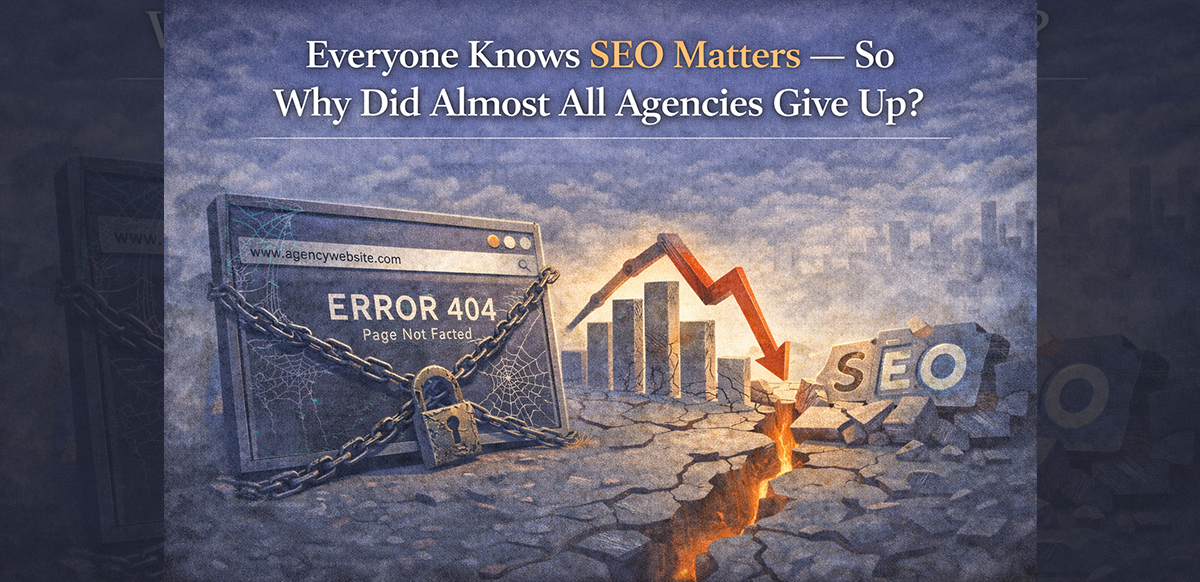
Agencies often give up on SEO because it takes time, consistency, and structured content planning. Long-term organic visibility requires patience beyond paid ads and social posts.
Ask any agency principal a simple question: "Is organic traffic important?" Almost everyone answers: "Yes."
Ten years ago, many agencies acted on that belief. They built websites, paid for SEO, and launched blogs. Today, most of those sites are gone. If you try to visit them now, you'll find 404 errors, expired domains, or abandoned WordPress installs.
This was not an accident. And it was not because SEO "stopped working."
Most agency websites failed for one reason: The boss outsourced responsibility instead of owning the system.
SEO was treated as a vendor problem, a budget item, or a technical black box. The thinking was: "I don't need to understand SEO. I'll pay someone to handle it."
Almost all agencies that took this approach failed. Not slowly—completely.
The typical setup was a cycle of genericism:
The result? Articles written by non-practitioners that could apply to any agency in any country. The boss never read them. The agents never used them. The content had zero operational intelligence. It existed purely to try and manipulate a search engine.
Some sites ranked briefly through "Black Hat" shortcuts—keyword stuffing and fake traffic. It created a temporary high of false confidence. Then Google updated, and the house of cards collapsed.
After the collapse, most bosses drew a comforting conclusion: "SEO doesn't work for property agencies."
This absolved leadership of responsibility, but it was wrong. SEO didn't fail. Delegated SEO failed.
This is the uncomfortable truth: Most agency bosses were not unwilling to pay—they were unwilling to learn.
They refused to:
SEO is not a service; it is a management system. You can outsource execution, but you cannot outsource ownership.
Real SEO only works when it is tied to reality:
Third-party vendors do not have this information. Without an internal structure to capture this "Case Logic," content becomes fake and authority evaporates. Google isn't rewarding clever writing anymore; it is rewarding evidence of real expertise.
When company SEO failed, agencies made a pragmatic but dangerous move: they let agents handle visibility through TikTok, Instagram, and Reels.
To the company, it looks "free." But this is outsourced survival. When the agents leave, their audience and authority leave with them. The agency remains invisible, having built no institutional equity.
The few agency websites that still dominate today are often simple and understated. They survive because they are maintained internally and honestly. They aren't trying to "hack" the system; they are documenting the work.
If an agency wants SEO to truly work:
This doesn't mean the boss writes the blogs. It means the boss designs the system that turns daily work into digital visibility.
Most agencies didn't abandon SEO because it failed. They abandoned it because owning it was harder than outsourcing it.
Visibility built on delegation collapses. Visibility built on operations compounds.
Until agency leaders accept this, company-level visibility will remain abandoned—and institutions will remain fragile. This is not an SEO lesson; it is a leadership one.

Founder of ListingMine and author of Agent for Life. Building ERP for Malaysian real estate agencies since 2008 — and writing to reshape how agencies grow.
More about Marvin Foong →More articles in this topic
This article is one of the sources behind this assessment. Take it to see what you already know and what to read next.
Educational self-assessment. Not a licensing examination or professional certification.