Agencies struggle to scale when they depend only on people and transactions. The future belongs to agencies that build products, systems, data, and repeatable infrastructure.
For most property agency owners, the first day of the month is not exciting — it is stressful.
You may have just closed RM3 million in commissions, ranked No.1 for the quarter, and celebrated a record sales month… but on the 1st, the scoreboard resets to zero.
No carry-forward revenue.
No compounding momentum.
No accumulating assets.
The pipelines dry, the targets reset, and the entire business restarts from scratch.
This is not mismanagement.
It is the structural flaw of the traditional agency model.
A pure agency has no asset that survives the transaction.
| Industry | What Happens After a Sale | Why It Scales |
|---|---|---|
| Manufacturer | Same product can be sold 100,000 times | Output compounds without more labour |
| Insurance | One policy = 10–20 years of premiums | Recurring revenue |
| Bank | One loan = decades of interest | Yield compounds automatically |
| Property Agency | One deal = one payment | Income stops unless new work starts |
A manufacturer does not start from zero every month.
A bank does not re-originate its entire loan book.
An insurance firm does not rebuild its portfolio from scratch.
But a property agency does.
Remove the agents — the revenue disappears.
Remove the leaders — the organisation collapses.
The problem is not effort.
The problem is the absence of a compounding asset.
A traditional agency is trapped by three hard constraints:
That is why agencies spend 10 years building headcount,
then collapse in 2 years when one leader defects and takes 80 people along.
The treadmill is the agency — it only moves when people run.
The real value is in the engine you can sell, not the motion you must repeat.
The industry keeps repeating three lies.
They sound logical, but they are exactly why most agencies never scale:
Agencies don’t fail from lack of sales.
They fail because nothing they build survives the people who built it.
A product, in real estate, is anything you build once and monetise repeatedly without repeating the labour.
It can be:
The shift is simple but strategic:
Stop selling access to property.
Start owning the infrastructure, intelligence, or capital behind the transaction.
Example:
A one-man agent compiled monthly sales absorption rates of new launches in Klang Valley.
He standardised:
He then sold it to developers as a private subscription product at RM1,500/month.
No staff.
No extra work per new customer.
One dataset → multiple recurring buyers.
Result:
He earned more from data than from commissions — and became more valuable to developers than 100 agents trying to push units.
That is productisation at the smallest scale:
Build once → sell many times → revenue survives beyond labour.
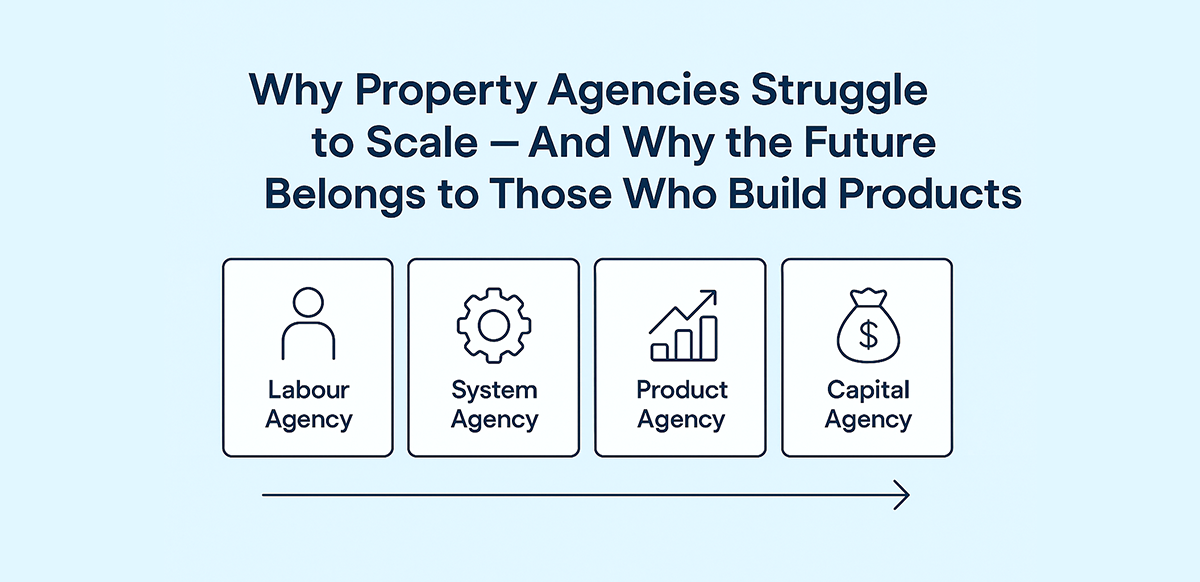
| Level | Model | Revenue Type | Ceiling |
|---|---|---|---|
| 1. Labour Agency | Commission only | One-time, effort-based | Hard ceiling |
| 2. System Agency | SOPs, IP, onboarding, playbooks | Internal leverage | Higher but still human-bound |
| 3. Product Agency | Data, SaaS, verified listings, finance tools | Subscription, licensing, margin | Compounding |
| 4. Capital Agency | Yield pools, rent-guarantee funds, JV structures | Recurring, asset-backed | Infinite ceiling |
Most agencies are stuck at Level 1.
A few reach Level 2.
Almost none reach Level 3.
But the future belongs to Level 4.
You don’t need engineers, a CTO, or VC money to productise.
You just need something that:
Survives you
Sells more than once
Does not depend on daily labour
| Product Path | Built Once → Sold Many | Example |
|---|---|---|
| Data Product | Market intel, PSF trends, loan attrition | Developer subscription |
| Workflow / IP Product | Training, scripts, SOP licensing | Sell your playbook |
| Platform Product | ACN, lead routing, verified inventory | Charge access, not labour |
| Marketplace Product | Control matching power | Monetise both sides |
| Capital Product | Yield even when nothing moves | RBF, commission advance, bulk purchase |
Pattern:
Labour earns once.
Products earn repeatedly.
Capital earns even when nothing moves.
| If you already have… | Your fastest product path is… | Why |
|---|---|---|
| Data, market insight, developer history | Data Product | You already collect it — you just haven’t monetised it yet. |
| Strong SOPs, training, onboarding culture | Workflow / IP Product | Your internal system is a product others will pay to copy. |
| A REN base or growing network effect | Platform Product | The more people use it, the stronger and more defensible it becomes. |
| Access to buyers, sellers, inventory, leads | Marketplace Product | You monetise matching power, not labour. |
| Trust, cashflow, investor network, or developer links | Capital Product | When you control the money, you control the industry. |
Key Principle
If your strength is knowledge, monetise data.
If your strength is people, monetise workflow or platform.
If your strength is deal flow or capital, monetise money.
You can also build two in parallel:
Data + Platform
Marketplace + Capital
Workflow + Licensing
Service agencies add agents.
Product agencies add revenue layers.
| If you use ListingMine for… | The real product you now own is… |
|---|---|
| Private CRM + Listing Vault | A portable, agent-owned inventory asset |
| ACN Co-Broking Network | Your own Beike-style cooperation network |
| Developer Listing Distribution | Your agency becomes a listing supplier |
| ERP + Commission Engine | A no-code revenue machine others plug into |
| PropertySifu Exposure | A public-facing product powered by your private data |
ListingMine does not make you a better agent. The treadmill is the labour. ListingMine is the engine you can sell. It makes your agency something others must plug into — and that is a product.
| Path | What You Become | Product Example |
|---|---|---|
| Bulk Purchase Exclusivity | Portfolio allocator / master distributor | Pre-book developer units, resell with control & margin |
| Commission Advance (RBF) | Yield provider backed by commissions | Advance to agents, collect when developer pays |
| Developer Receivable Fund | Bridge-finance partner | Advance to developers, receive better commission |
| Lead Procurement Exchange | Demand aggregator | Buy traffic in bulk, sell verified leads |
| M&A / Roll-Up | Platform parent | Plug acquired teams into same ERP instantly |
Bulk Purchase = control supply.
Commission Advance = turn delayed payout into recurring yield.
If you want to explore this layer:
Speak directly with the ListingMine founder.
This level is not a feature — it is a business model transformation.
ListingMine does not acquire agencies.
But it allows any agency that wants to scale through M&A to do it without system chaos.
If you stay independent forever — ListingMine works.
If you ever want to acquire or be acquired — ListingMine makes you acquisition-ready.
The world’s clearest proof that an agency becomes unstoppable when it productises:
Lianjia (agency) → Beike (platform + ACN + verified inventory)
What they productised:
Outcome:
Listed on NYSE in 2020 at USD 23 billion —
Not as a portal.
Not as a franchise.
But as a productised agency network.
Key truth:
Beike is still a property agency. It just owns the system everyone else depends on.
They did not escape the agency model.
They upgraded it.
Old-model agencies ask:
“How do we close more deals this month?”
Product-driven agencies ask:
“What can we build once, that 1,000 people will pay for?”
The agency with the most RENs will not win.
The agency with the most infrastructure, product, and capital leverage will.
The future is not headcount.
The future is ownership.
If your income resets to zero every month, you don’t own a business — you rent one.
The future belongs to those who own the engine, not the motion.
Build something that pays you after the work is done.

Founder of ListingMine and author of Agent for Life. Building ERP for Malaysian real estate agencies since 2008 — and writing to reshape how agencies grow.
More about Marvin Foong →More articles in this topic