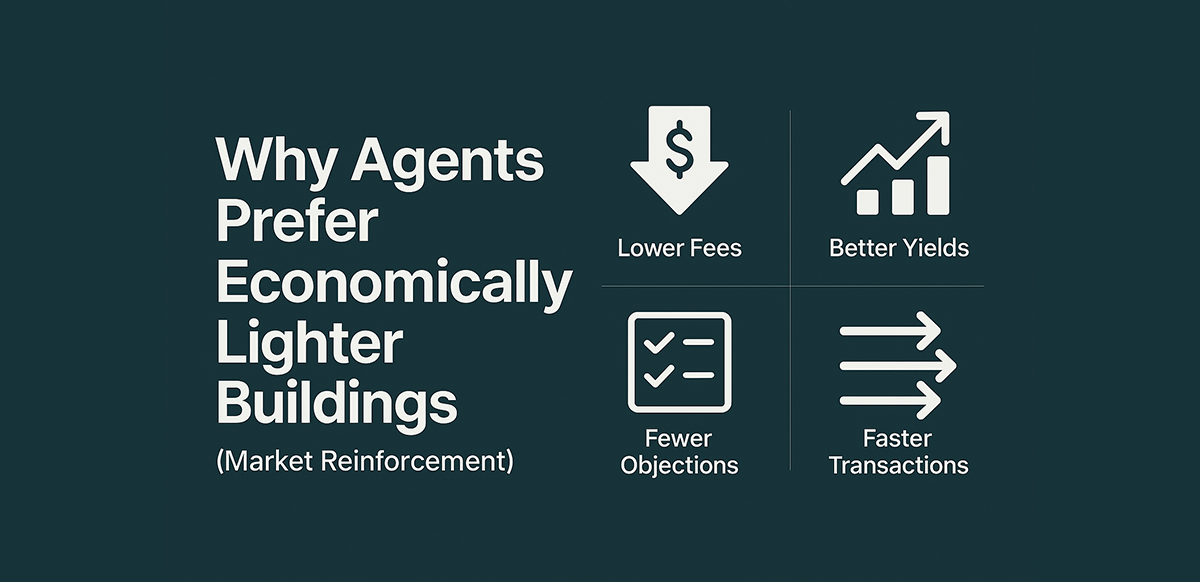
Agents concentrate on buildings where transactions are easier, demand is stronger, and income probability is higher. Market reinforcement makes profitable buildings attract more agent effort.
Property agents are often treated as a distribution problem. Increase commissions, improve brochures, amplify marketing—and demand will follow. That belief misunderstands how agents actually behave.
Agents do not sell what is prettiest. They sell what converts, what moves quickly, and what does not create friction in the transaction.
When a building is materially cheaper and easier to own than nearby alternatives, the market does not need persuasion. It reorganises itself.
Agents are not ideological actors. They are economic ones. Their daily decisions are shaped by:
A building that reduces friction at any of these points becomes easier to sell—regardless of branding, architecture, or amenities.
This effect is strongest in mass-market and investor-led segments, where yield sensitivity and transaction velocity dominate decision-making.
Every experienced agent recognises this sequence.
The buyer likes the unit. The location works. The price is acceptable. Then the question inevitably comes: “How much is the maintenance fee?”
High fees are not just a cost. They are an objection multiplier. They trigger:
A building with materially lower net fees removes this objection early. For agents, this matters more than almost anything else. Fewer objections mean:
This is not about convenience. It is about agent economics. Reducing the number of required viewings and follow-ups—even by a third—materially increases effective hourly income for the same commission. Buildings that are cheaper to own are productivity multipliers.
A large portion of the secondary market is investor-led. Investors do not buy narratives. They buy numbers.
Consider two comparable RM500,000 units:
That difference is roughly RM3,600 per year. For leveraged or marginal investors, this gap often determines whether:
Agents learn quickly which buildings produce fewer yield objections. They prioritise them—not because they are instructed to, but because the mathematics closes deals faster.
Agents are paid on success, not effort.
A building that:
is economically superior for the agent. Speed matters. Velocity matters. Agents prefer deals that move cleanly over deals that promise higher commissions but consume more time, emotional energy, and reputational risk.
Agents remember buildings that create problems after the sale. High and rising fees generate:
A building that:
creates the opposite effect. Satisfied buyers refer. Agents are rational. They protect their future pipeline.
Once agents identify a building as:
listing density increases.
Higher listing density leads to:
Liquidity improves. Improved liquidity attracts more agents. This is not marketing. It is market reinforcement.
Developers often attempt to solve slow sales with:
These are temporary distortions. They do not change the product’s ownership economics.
Agents know the difference between:
No commission structure can compensate for long-term holding friction.
The preference gap widens as buildings age. As operating costs rise:
Agents adjust their mental maps accordingly.
Over time:
At that point, the building markets itself through agent behaviour alone.
When:
a reinforcing loop forms. No stakeholder needs to be convinced. The market reallocates attention automatically.
Agents do not need to believe in economically lighter buildings. They only need to experience them.
Once agents realise that:
preference becomes inevitable. This is how markets work.
You cannot advertise your way out of a structurally heavy product. But you can design your way into one the market prefers to sell.
Not by persuasion. By structure.

Founder of ListingMine and author of Agent for Life. Building ERP for Malaysian real estate agencies since 2008 — and writing to reshape how agencies grow.
More about Marvin Foong →More articles in this topic
This article is one of the sources behind this assessment. Take it to see what you already know and what to read next.
Educational self-assessment. Not a licensing examination or professional certification.