Many agents prefer subsale because project sales involve payout delays, cancellations, developer dependency, and heavy competition. Subsale can feel more controllable and practical.
A structural shift is happening in the industry.
More agents are quietly moving back to subsale — not because subsale is easier, but because subsale offers what project selling no longer reliably provides: cashflow, control, and economic stability.
Below is the clean structural breakdown of why this shift is accelerating in 2026.
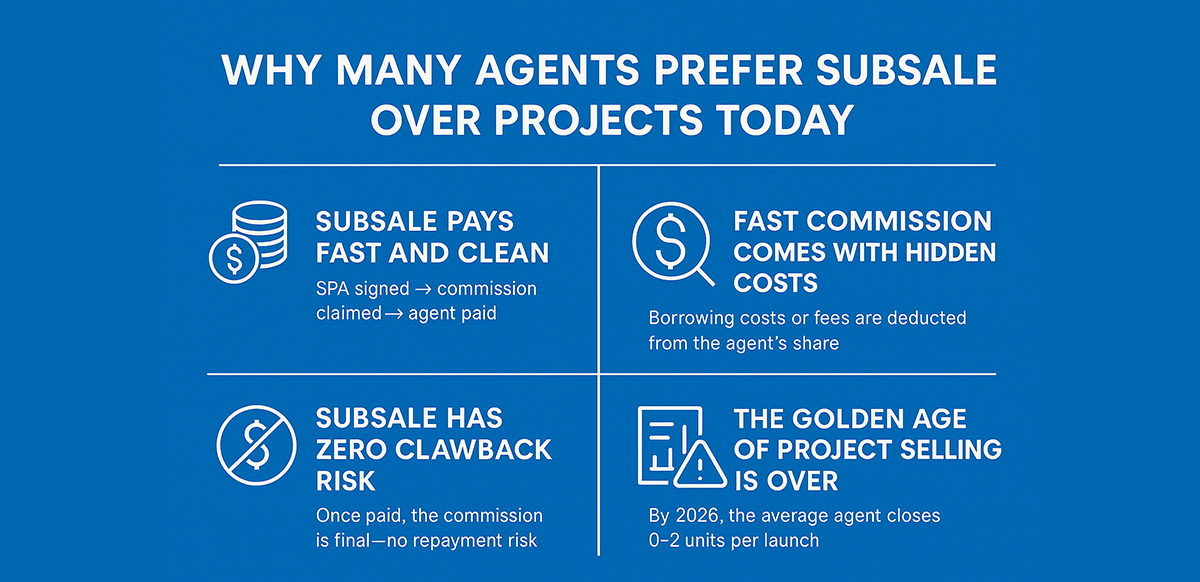
Subsale operates on a simple and powerful formula: SPA Signed → Commission Claimed → Agent Paid.
No long waiting cycles.
No progressive billing delays.
No “fast commission” deductions.
Subsale provides certainty of income, and in this industry, certainty is survival.
In project sales, fast commission is funded by borrowed capital — bank facilities, P2P lenders, private lenders, or internal agency credit. Because borrowed money has a cost, interest or admin fees are deducted from the agent's share.
So while the agent receives money sooner, they receive less of it. Subsale avoids this entirely.
When a project SPA collapses after a fast payout, that payout instantly becomes a debt. Most agents cannot repay because the money is already spent.
Debit notes only work if the agent stays and continues producing.
Many simply leave for a new agency, and the clawback becomes a permanent loss.
Subsale has none of this. Once paid, you are paid — cleanly and finally.
There was a period when one agent could sell 10–20 units in a single launch. That era was driven by:
By 2026, the landscape has changed dramatically:
Today, the average agent closes 0–2 units per launch — down from 10+ in the 2018–2022 era. The economy of scale is gone. If one agent sells only one unit, the effort required is now the same as subsale — but with more risk and slower payout.
Project units are commodities — every agent sells the same product with the same brochure. Subsale units are unique assets:
In subsale, you differentiate by skill, not by brochure ownership. And subsale is ACN-ready — listings can be shared, co-broked, and scaled across networks without project restrictions.
Project sales today depend heavily on:
Subsale rewards:
Subsale agents build durable careers; project agents ride waves that may or may not come.
Subsale offers the closest thing to predictable income in a volatile industry:
Option A: Project-Centric Agencies Continue selling projects — but only those with real buyer-side value. Create elite, specialist teams trained for tight launch cycles and high-volume funnels. Accept high turnover.
Option B: Hybrid Agencies (The Future Winners) Blend both worlds:
Use Project Sales for branding, recruitment, and top-funnel exposure.
Use Subsale for agent cashflow, stability, and ACN expansion.
This model produces the strongest culture, lowest attrition, and most balanced revenue.
Project selling once promised scale. Today, that scale is gone for most agents.
Subsale restores what the modern negotiator needs most: Speed, control, and certainty.
Projects promised scale. Subsale delivers survival. And in 2026, survival wins.

Founder of ListingMine and author of Agent for Life. Building ERP for Malaysian real estate agencies since 2008 — and writing to reshape how agencies grow.
More about Marvin Foong →More articles in this topic
This article is one of the sources behind these assessments. Take one to see what you already know and what to read next.
Educational self-assessment. Not a licensing examination or professional certification.