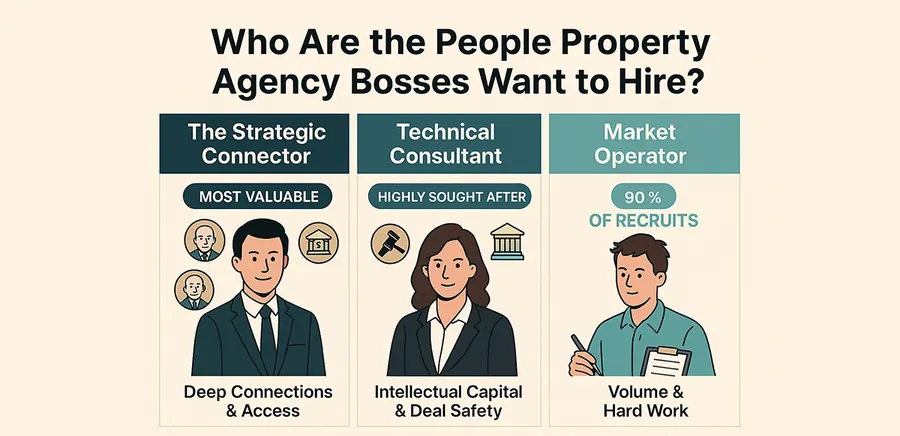
Agents from other industries may bring sales discipline, financial literacy, service habits, or relationship skills. External experience can become an advantage in real estate.
This insight is not born of theory. It emerges from following the “proper path” as early as possible—and discovering exactly where that path quietly stops working.
The founder of ListingMine graduated at 22 years old. That detail matters—not because youth implies brilliance, but because it removes contamination.
At 22, there was:
There was only academic preparation. This makes the founder a clean test case of Malaysia’s official education-to-profession pipeline—unshaped by external commercial logic. What followed exposed not individual weakness, but a structural gap that thousands encounter later, with far higher stakes.
On paper, the ideal professional journey looks like this:
This is the model regulators understandably want to see. But embedded within it is a silent assumption:
That the environment graduates are trained for will still exist when they reach mid-career.
That assumption is no longer true.
Immediately upon graduation, the system performs a quiet sort. Not by intent—but by structure.
Track One — The Protected Path
Graduates with strong academic results are funnelled into international consultancy and valuation firms.
Inside these environments:
Some large local mandates still exist, but these are typically:
Graduates here are trained to be:
This is often described as professionalism. In practice, it is market insulation. They are trained to operate inside a system—not to compete in an open market, and certainly not to design one.
Track Two — The Exposed Path
Graduates who do not enter protected consultancies move directly into retail agencies.
From day one, they face:
They learn how the open market actually functions—quickly, or not at all.
Globally, retail agencies exhibit extremely high early-career attrition. Malaysia is no exception. Most new entrants do not survive their first few years. This is treated not as failure, but as a structural constant of the business.
The irony is not moral. It is mechanical:
This does not make one group smarter or better. It means they are trained for different realities.
This split matters.
When Malaysia’s principal estate-agency legislation—Act 242—was shaped, many contributors were principals of large consultancy and valuation firms.
Naturally, regulation reflected:
Retail-agency realities were far less visible:
This was not malicious. It was structural bias.
Over time:
Only in recent years have retail-agency leaders begun sitting on the Board of Valuers, Appraisers, Estate Agents and Property Managers, allowing ground-level realities to enter regulatory discussion.
This is progress. But education still lags practice—and every year that lag persists, agencies repeat the same failures with higher stakes and thinner margins.
A small number of former consultants remain attached to international brands after leaving their firms.
This happens because:
This path is often romanticised.
In reality, it is:
Using these exceptions to justify the pipeline is like using lottery winners to justify retirement planning.
The real failure emerges later.
Typical timeline:
By mid-career:
At this point, many professionals discover:
Retail agency becomes the only viable option. But retail agencies operate on an entirely different logic.
Retail success depends on systems formal education barely addresses:
Commission design is not a side detail. It is the cultural engine of every agency.
In practice, many working commission models were imported from other industries—insurance, unit trust distribution, corporate sales, MLM —not from property textbooks.
Outsiders brought this language in.
Academically, the term is co-agency. In practice, the market lives co-broking.
They are treated as synonyms. They are not.
Education defines co-agency as:
The market lives co-broking as:
Education stops at the word. The market builds the operating system.
This is the root issue. An industry without language lacks thinking tools.
You cannot:
Graduates are therefore forced to:
This is not a talent problem. Many capable professionals followed the rules, did everything right, and still found themselves trapped.
The failure is structural. Specifically, it is a language failure.
ListingMine Academy did not emerge to “train agents.” It emerged because the industry ran out of language.
Not certification. Not motivation. A terminology and model factory.
Concepts such as:
were not invented to sound clever. They were named because systems cannot exist without language.
The 1000 essays are not content. They are a reconstructed operating manual for how the Malaysian property-agency industry actually functions.
Agents entering from other industries—insurance, unit trust distribution, corporate sales, technology—arrive with:
They already possess vocabulary.
In the last decade, this has stopped being a marginal pattern. Among the largest and fastest-scaling agencies built in Malaysia, it is increasingly common to find founders whose prior training came from outside real estate—not from traditional agency apprenticeship.
This is not a coincidence. Because with vocabulary, they:
They outperform not because they are rebels. They outperform because they were trained for commercial reality, while others were trained for institutional protection.
Language alone is not enough. If ListingMine Academy provides the language, the platform must provide the syntax.
You cannot run complex ACN logic on spreadsheets for the same reason you cannot compose symphonies on calculators.
The tool must match the vocabulary. This is where most agencies stall.
One mid-sized agency redesigned its commission logic after a recruitment slowdown. The logic took two meetings to agree on. Implementing it required six weeks and RM18,000 in customisation. The experiment was never repeated—not because it failed, but because change was too expensive.
When change is expensive:
This is not a software problem. It is strategic paralysis.
Modern agencies operate complex economic systems without infrastructure designed for them.
They must manage:
Yet most still rely on:
ListingMine exists to remove that paralysis.
Not as a portal. Not as a rigid ERP. But as an IDE for real-estate economics—an execution environment where agencies can model, test, and evolve their logic without being held hostage by software vendors.
It could only be built from an in-out-in vantage point: education → professional training → agency practice → systems design → strategic re-entry.
The language now exists.
The syntax now exists.
The infrastructure now exists.
Markets will decide. But they always select for systems that can evolve faster than people can argue.
Design the system—or be constrained by it.

Founder of ListingMine and author of Agent for Life. Building ERP for Malaysian real estate agencies since 2008 — and writing to reshape how agencies grow.
More about Marvin Foong →More articles in this topic