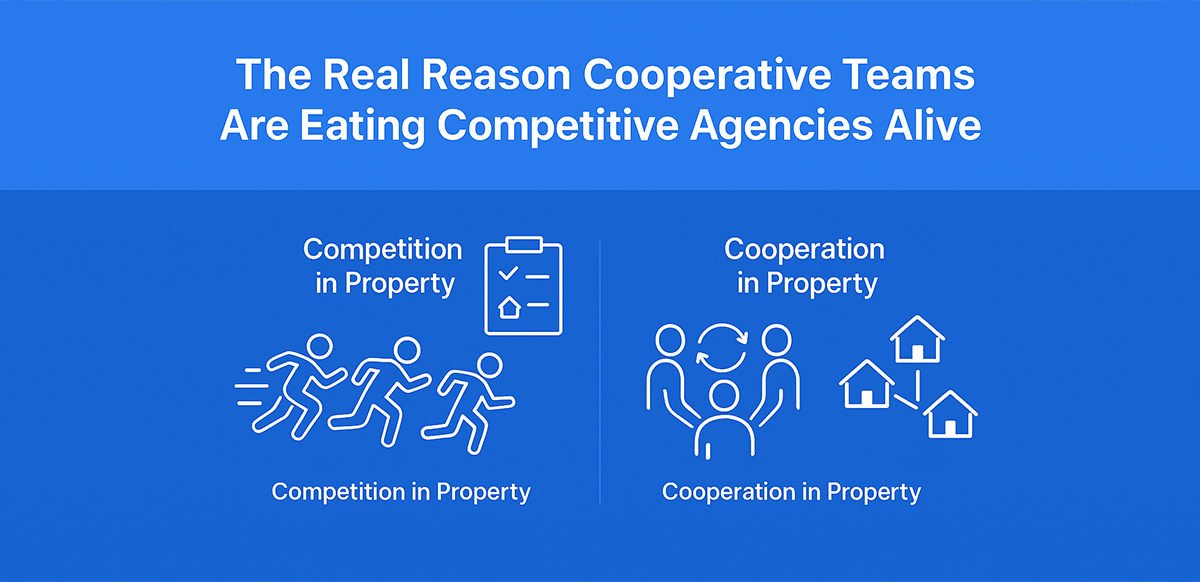
Cooperative teams outperform purely competitive agencies because members share roles, information, and workload more effectively. Structured collaboration can beat isolated individual performance.
The property industry still worships competition. Agents are trained to outwork, outspend, and out-hustle one another. Listings are guarded. Leads are hoarded. Credit is disputed. Everyone fights for the same shrinking pool of attention. From the outside, this looks energetic. From the inside, it is inefficient, exhausting, and structurally self-destructive.
Competition feels productive. Cooperation is productive.
Competition rewards speed:
This works in simple markets. Property is not a simple market. A single transaction requires:
No single agent excels at all of these at once. Competition fragments capability. Cooperation recombines it.
At its core, property is not persuasion. It is matching:
Competition shrinks the matching pool. Cooperation expands it. When listings are hoarded, liquidity dies. A hidden listing has a value of zero until it is matched. Deals slow not because demand disappears — but because information cannot flow. Cooperation unlocks that value.
Competition in Property
Cooperation in Property
Same market. Different math.
In a competitive model:
Most of that spend creates heat, not progress. In a cooperative model:
The same reach is achieved with:
This is why cooperative teams consistently see:
This is not culture. It is math.
Competition turns internal relationships into zero-sum games:
Energy that should go into execution goes into defence. Cooperation replaces arguments with rules:
When friction is designed out, performance rises automatically.
Competition can sharpen skills — briefly. Over time, it produces:
The industry confuses survival with excellence. In cooperative systems, people stay long enough to:
Excellence requires time. Competition shortens careers. Cooperation lengthens them.
The most efficient markets in the world are cooperative at the core:
They compete at the edges — but cooperate on infrastructure. Property remains one of the last major transaction markets still pretending that isolated competition produces better outcomes. It does not.
This is the usual fear — and it's wrong. Cooperation does not mean:
In properly designed cooperative systems:
It becomes harder to hide in cooperation than in competition.
Competition creates noise. Cooperation creates liquidity. Competition looks exciting. Cooperation compounds quietly. In property, the winners are not those who fight hardest —
but those who match best. And matching, by definition, is a cooperative act.
That is why cooperative teams are not just surviving. They are eating competitive agencies alive.

Founder of ListingMine and author of Agent for Life. Building ERP for Malaysian real estate agencies since 2008 — and writing to reshape how agencies grow.
More about Marvin Foong →More articles in this topic