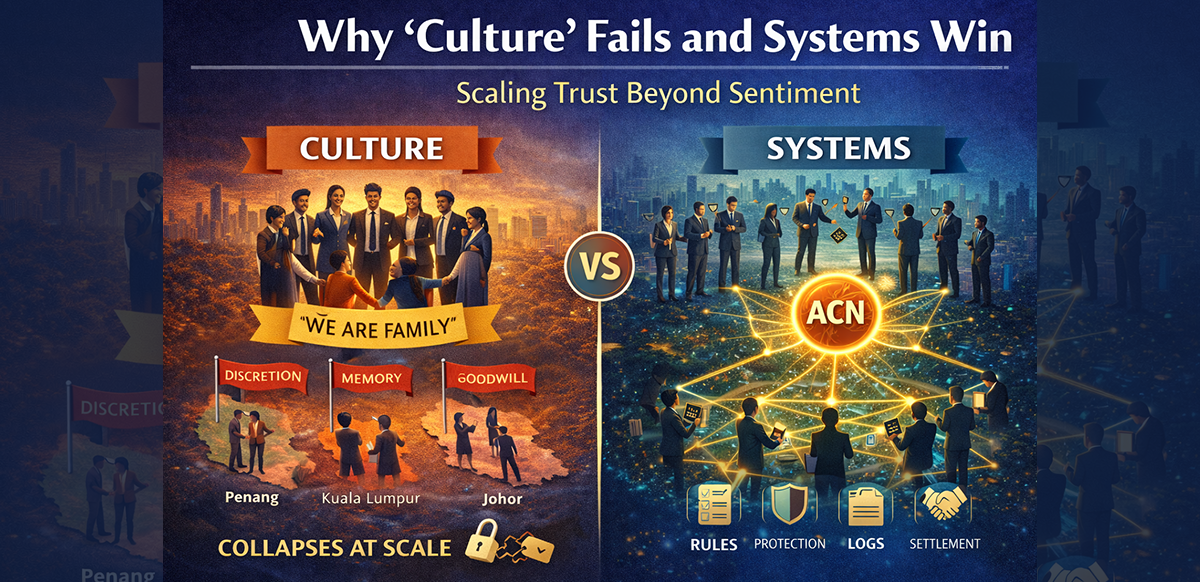
Culture becomes weak when it is not supported by rules, records, and incentives. Systems scale trust more reliably than slogans.
Every struggling agency eventually says the same thing: "Our problem is culture." In response, the principal doubles down on bonding sessions and reminders that "we are family." For a while, it works. Then the agency grows past a certain size, and culture stops working. Not because people became worse, but because culture cannot scale trust.
Culture feels powerful because it works at a small scale (10–15 agents). In a small office, trust is personal and behavior is visible. Deviations are corrected socially over coffee or in the office. Principals often confuse this localized social pressure with a permanent business structure.
At scale, the shared context that fuels culture is destroyed by three factors:
At 50+ agents, "family" stops being a description and becomes rhetoric. Rhetoric does not resolve a dispute over a high-rise lead in Johor.
When systems are weak, trust defaults to the principal. Every dispute becomes a request for the boss to "decide." This creates a Discretionary Power Trap:
An Agent Cooperation Network (ACN) does not attempt to "build culture" through speeches. It replaces emotional trust with Systemic Trust through:
Instead of asking "Who do we believe?", the system provides the data. Trust is no longer emotional; it is mechanical.
Most principals believe that if they fix the culture, the systems will follow. Reality is the opposite. When systems are clear, fair, and enforced by data, anxiety drops. When anxiety drops, cooperation increases.
What we call "good culture" is often just the output of predictable, fair systems.
Culture cannot scale trust. In the modern Malaysian property market, agencies do not fail because they lack values—they fail because they mistake sentiment for structure. If your culture requires constant reinforcement and speeches, it is already failing. Strong systems don't need speeches; they quietly produce the behavior everyone calls "culture."

Founder of ListingMine and author of Agent for Life. Building ERP for Malaysian real estate agencies since 2008 — and writing to reshape how agencies grow.
More about Marvin Foong →More articles in this topic