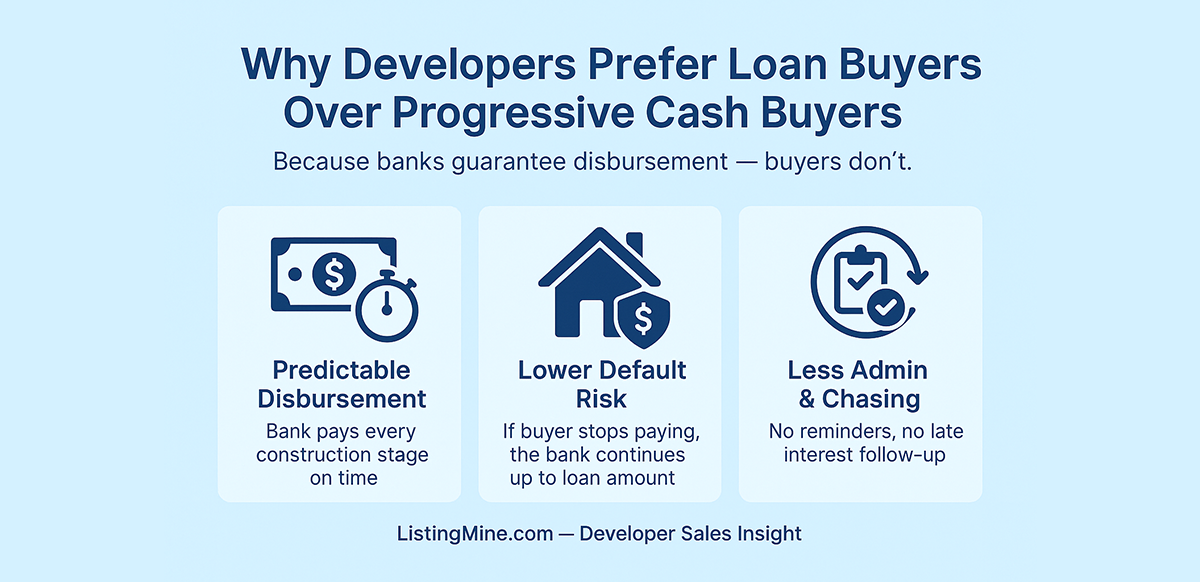
Developers may prefer loan buyers because financing structures, documentation, and sales process can better support project accounting or buyer commitment. Cash buyers are not always automatically better.
The Cash-Flow Logic Behind Developer Sales Strategy in Malaysia
In sub-sale transactions, a "cash buyer" is often seen as the strongest purchaser: fast, clean, and financing-risk free.
However, in new development sales in Malaysia, the preference is not the same. Many developers quietly prefer loan buyers over progressive cash buyers unless the cash is paid fully upfront.
The reason is not emotional, but operational: A bank-financed buyer gives the developer predictable, scheduled cash flow, which is crucial for managing construction costs and project financing. Developers manage construction cash cycles, loan drawdowns, and contractor payments—for them, payment certainty is more valuable than buyer image.
Under Malaysia’s Schedule G/H system, buyers pay in stages according to construction progress.
| Payment Type | Who Pays Progressively? | Reliability & Certainty | Impact on Developer Cash Flow |
|---|---|---|---|
| Loan Buyer | The Bank (up to the loan amount) | High (Disbursements are tied to architect certification, arriving on a fixed, traceable timeline.) | Stable and forecastable. |
| Cash Buyer (Progressive) | The Individual Buyer | Unreliable (Delays are common due to personal funds not being ready, travel, or disputes.) | Unstable, requires internal administration (chasing payments, computing late interest). |
| Cash Buyer (Full Lump Sum) | The Individual Buyer | Highest (Only if paid 100% upfront at SPA signing.) | Immediate capital infusion. |
A loan buyer removes the risk of individual payment delays; the developer deals only with the bank's reliable financing process.
Once a loan is approved and the Letter of Offer is signed, the bank assumes the responsibility of timely payment to the developer.
A progressive cash buyer creates administration, uncertainty, and risk unless they pay everything upfront.
Developers strongly prefer a cash buyer only when the buyer pays 100% upon SPA signing.
In that ideal scenario:
This is why some developers offer direct cash settlement discounts (often 2%–5%)—they are buying cash flow certainty and reduced operational costs.
While both types of buyers can default before Vacant Possession (VP), the impact on the developer is significantly different.
| Scenario | Loan Buyer Default | Progressive Cash Buyer Default |
|---|---|---|
| Who continues payment? | The bank (up to the loan amount) is obligated to pay the certified progress claims. | No one — the developer is stuck. |
| Who handles recovery? | The bank handles the legal process and auction of the property. | The developer must pursue recovery individually, diverting resources. |
| Financial Exposure | Shared with the bank (bank absorbs part of the loss). | 100% on the developer (full exposure). |
A loan buyer may default, but the bank will not default on its obligation to the developer for certified progress claims. This shields the developer from the direct impact of buyer insolvency.
Developers are not choosing based on "cash vs. loan." They are choosing based on certainty vs. uncertainty.
| Type of Buyer | Developer Confidence | Reason |
|---|---|---|
| Full Cash (100% upfront) | Highest | Immediate and complete settlement. |
| Loan Buyer | High | Bank guarantees scheduled staged payments. |
| Progressive Cash Buyer | Lowest | Individual timing and payment risk disrupts project cash cycle. |
The strength of a buyer in project sales is defined by the predictability of the payment source.
Suggested Script for Agents:
"In subsale, cash is king. But in new projects, the developer needs guaranteed progress payments to meet construction deadlines. If you take a loan, the bank guarantees the payments on time. If you pay cash progressively, the developer has to rely on you every stage—which creates uncertainty and slows their financing cycle."
Final Takeaway:
A "cash buyer" is only an advantage in new development sales if the cash is paid in full at SPA. Otherwise, a loan buyer is the more valuable buyer because the bank guarantees disbursement, reduces admin work, and lowers default risk for the developer.

Founder of ListingMine and author of Agent for Life. Building ERP for Malaysian real estate agencies since 2008 — and writing to reshape how agencies grow.
More about Marvin Foong →More articles in this topic
This article is one of the sources behind this assessment. Take it to see what you already know and what to read next.
Educational self-assessment. Not a licensing examination or professional certification.