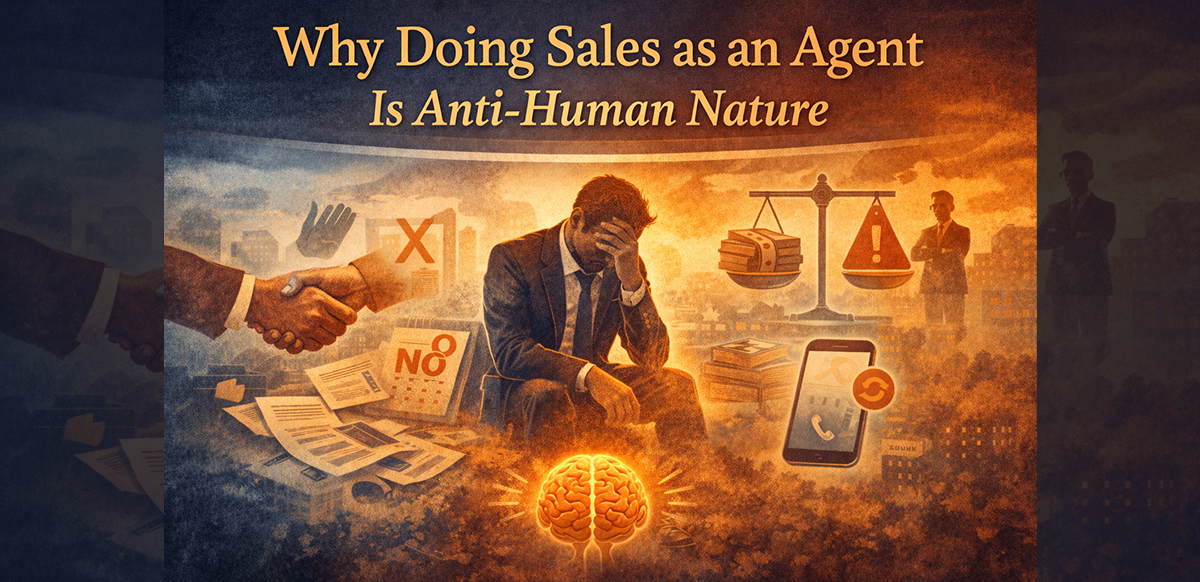
Sales forces agents to face rejection, uncertainty, and social discomfort repeatedly. Success requires systems and mindset to overcome natural avoidance.
Almost anyone can become a property agent. Very few survive. This contradiction confuses the public, but the answer is precise: Sales work—especially in the Malaysian property context—is structurally anti-human nature.
Sales roles attract people by promising autonomy, uncapped income, and merit-based rewards. But once inside, the daily reality collides violently with human biology. Sales asks humans to repeatedly do exactly what the human nervous system is evolved to avoid.
Humans evolved to avoid rejection because, in an ancestral environment, exclusion meant death. Our brains are hardwired to treat social snubs as physical threats.
Sales requires:
No other profession normalizes rejection as a primary job function. To the brain, every "not interested" triggers threat circuitry. Most agents do not fail from a lack of skill; they fail from rejection accumulation.
Human motivation relies on a visible cause-and-effect loop. Sales break this loop entirely.
An agent can work for weeks—conducting viewings, blasting listings, and following up—with zero income or reinforcement. When the brain sees effort producing no signal, it triggers energy conservation. The brain concludes that "effort does not matter," and motivation collapses. This is not laziness; it is a biological response to uncertainty.
Most professions allow you to learn and fail in private. Sales exposes failure publicly.
In property, your mistakes are visible to clients, your income is often a matter of public comparison within the agency, and your performance is tied directly to your personal identity. Humans can tolerate failure, but we find unprotected humiliation intolerable. This is why agents procrastinate on outreach—avoidance is not a sign of weakness; it is a subconscious act of self-protection.
Humans need a stable identity to function. Sales fractures this by tying self-worth to fluctuating pipelines.
One month, you are a "Top Producer."
Next month, you are invisible.
Few humans can psychologically withstand being "judged" from zero every thirty days. This instability fractures the self-concept, leading to the high burnout rates we see across the industry.
The Malaysian agency model is often built on an unspoken, cynical assumption: "Most people will quit; a few will survive."
This is why training is often shallow and systems remain manual. The industry expects attrition, so it doesn't invest in the psychological architecture required for sustainability. Survivors are mythologized as "naturals" or having "grit," while those who leave are blamed for being "weak."
The truth is simpler: The job is anti-human unless buffered by structure.
Sales becomes a sustainable profession only when systems are designed to:
Sales is not hard because people are weak; it is hard because it violates fundamental human wiring. The future of the industry does not lie in "tougher" agents. It lies in building systems that stop fighting human biology.
Until then, sales will remain the easiest profession to enter—and one of the hardest to survive.

Founder of ListingMine and author of Agent for Life. Building ERP for Malaysian real estate agencies since 2008 — and writing to reshape how agencies grow.
More about Marvin Foong →More articles in this topic
This article is one of the sources behind this assessment. Take it to see what you already know and what to read next.
Educational self-assessment. Not a licensing examination or professional certification.