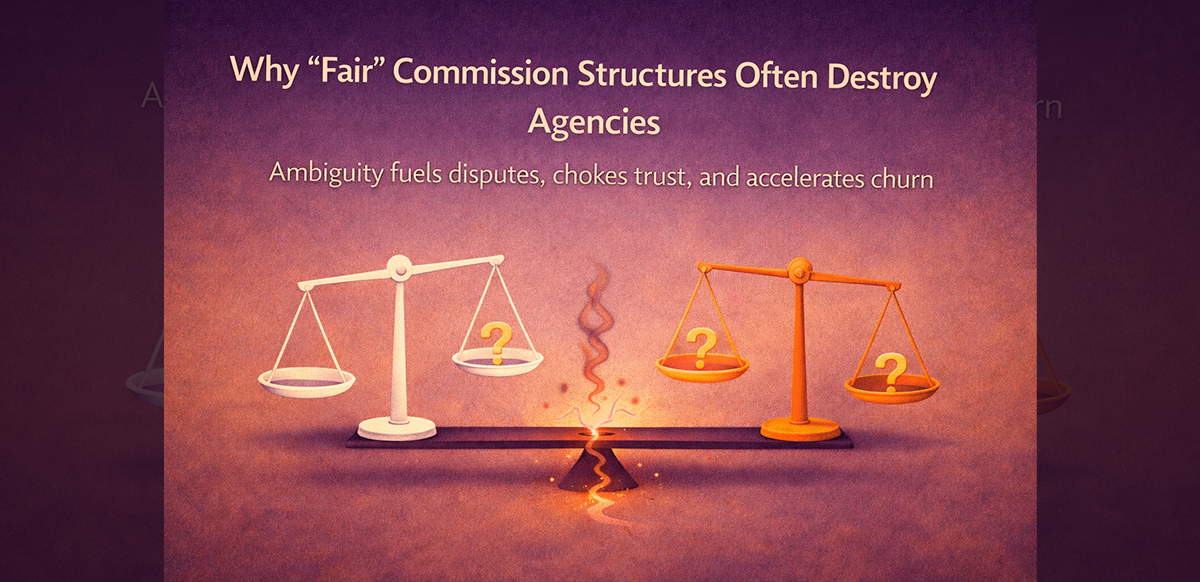
Fairness becomes dangerous when it is subjective, inconsistent, or financially unsustainable. Agencies need transparent rules instead of emotional payout decisions.
Most agency principals start from a good place. When they design commission structures, their intention is noble: "I want to be fair."
They allow flexibility for special cases, adjust splits to keep the peace, and approve discretionary bonuses to reward effort. They step in personally when deals become messy, believing that their personal fairness will build loyalty.
In practice, fairness does the opposite. In a commission-based business, fairness is the enemy of clarity. Ambiguity—not greed—is what quietly destroys agencies.
Agents rarely leave agencies because of headline split percentages. They leave because of volatility.
An agent will happily accept a predictable 70% split—paid on time and calculated the same way every time—over a "potential" 85% split that is subject to negotiation and finalized in meetings.
When payouts depend on "fairness," income becomes uncertain. The moment commission stops being a right and becomes a discussion, trust collapses.
Fairness requires a judge. When a deal becomes complex, the principal steps in to decide what is "fair." But fairness depends entirely on where you sit:
When you resolve disputes through fairness, you don't solve the problem—you simply choose a winner. The person who "loses" doesn't see a fair boss; they see a biased one. This is how well-intentioned fairness quietly breeds resentment and corrodes culture from the inside out.
Every fairness-based system contains gaps. Those gaps are where conflict lives. When rules are flexible:
The consequences are predictable:
Friction multiplies
Shadow Labor explodes
This is not leadership. It is unpaid judicial work.
A logical commission system eliminates negotiation entirely. In a clarity-first system, payouts are mathematically determinable before the deal closes. Trust is placed in the process, not the person.
In a high-performance agency:
This is why many "low-split" corporate firms have higher retention than boutique agencies offering "fair" terms. They offer the one thing boutiques often don't: Undisputed logic. And logic creates peace.
ListingMine was not built to make commissions "fair." It was built to make them clear.
We take the special-case logic trapped in the principal's head and encode it into an immutable system. Overrides, splits, thresholds, and attribution rules are executed automatically—never negotiated emotionally.
We don't want you to be a fair boss. We want you to be a logical architect.
The greatest gift a principal can give an agent is not generosity. It is certain that they will never have to argue with their boss about money again.

Founder of ListingMine and author of Agent for Life. Building ERP for Malaysian real estate agencies since 2008 — and writing to reshape how agencies grow.
More about Marvin Foong →More articles in this topic
This article is one of the sources behind this assessment. Take it to see what you already know and what to read next.
Educational self-assessment. Not a licensing examination or professional certification.