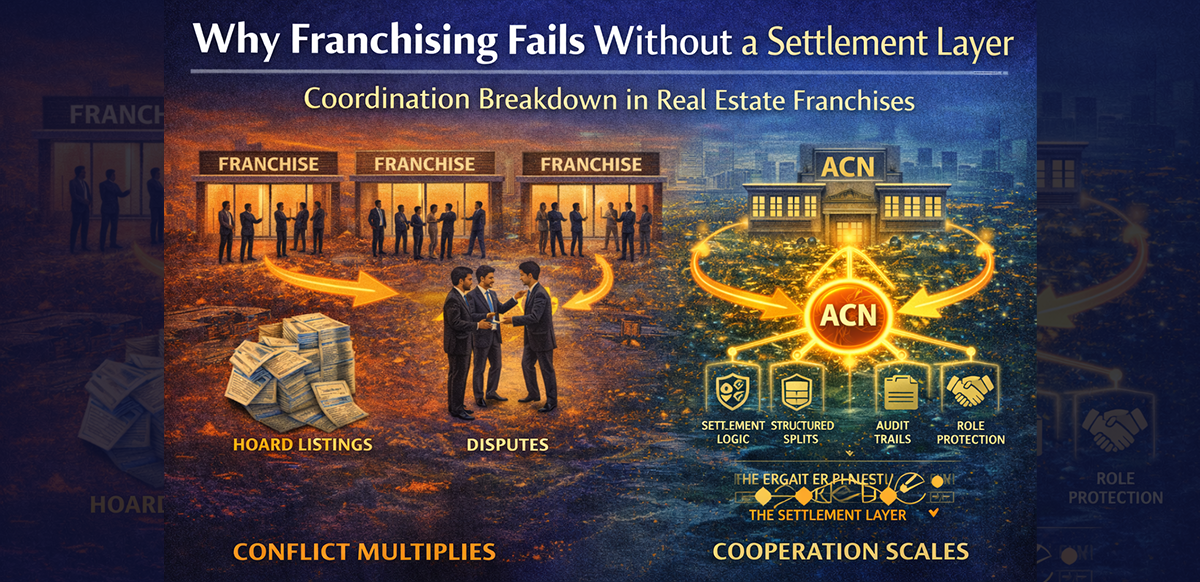
Franchising needs a settlement layer for commissions, cooperation, disputes, and workflow alignment. Without it, franchise networks remain loosely branded but operationally fragmented.
When a real estate franchise fails, the explanation usually sounds the same: "The franchisees weren't cooperative," "The brand wasn't enforced," or "The culture wasn't aligned." These are symptoms.
In the current Malaysian market—where re-registration under systems like MyFEX 2.0 is mandatory and the cost of business is rising—the real cause of collapse is structural: The absence of a settlement system. Most franchises don't fail because of weak branding; they fail because they cannot settle cooperation at scale.
Franchising promises a shared brand, shared standards, and shared growth. Founders assume that once multiple offices carry the same logo, cooperation will follow naturally. It doesn't.
Brand creates identity, not incentives. Identity alone cannot resolve the economic conflicts that arise when two independent business owners (franchisees) are asked to share a commission.
Once a franchise expands beyond a few offices, three predictable failures appear:
1. Franchisee Listing Hoarding
Franchisees quickly realize that listings are leverage. Without a guaranteed protection mechanism, sharing a listing with another branch feels like giving away 50% of the deal with 100% of the risk. In a high-competition environment, hoarding is rational risk management, not selfishness.
2. The Cross-Store Cooperation Breakdown
When franchisees do attempt to work together, the "hand-off" is often ambiguous. Who is responsible for the viewing? Who handles the loan follow-up? Without pre-defined roles, every cross-store deal requires a fresh negotiation. Eventually, agents stop sharing because the "coordination cost" is higher than the reward.
3. The HQ Arbitration Bottleneck
As disputes increase, everything flows upward to the Principal or HQ. Management is forced to decide who "deserves" the commission based on stories, not data. This leads to:
What these franchises lack is not more training or better culture; they lack a Settlement Layer. A settlement layer is the protocol that answers one question definitively: "Who gets paid, and why?"
Without this layer:
An Agent Cooperation Network (ACN) introduces what franchising alone cannot: a systemic settlement mechanism. Instead of HQ deciding outcomes, the protocol does.
ACN enables:
Settlement moves from people to protocol.
Most real estate franchises fail quietly. Not in headlines, but through listing hoarding, internal rivalry, and the exhaustion of the founder.
Brand creates visibility. Training creates competence. But only a settlement layer creates cooperation at scale. In Malaysia's landscape, ACN is not just a "franchise enhancement"—it is survival infrastructure. Without it, growth doesn't multiply value; it only multiplies conflict.

Founder of ListingMine and author of Agent for Life. Building ERP for Malaysian real estate agencies since 2008 — and writing to reshape how agencies grow.
More about Marvin Foong →More articles in this topic
This article is one of the sources behind this assessment. Take it to see what you already know and what to read next.
Educational self-assessment. Not a licensing examination or professional certification.