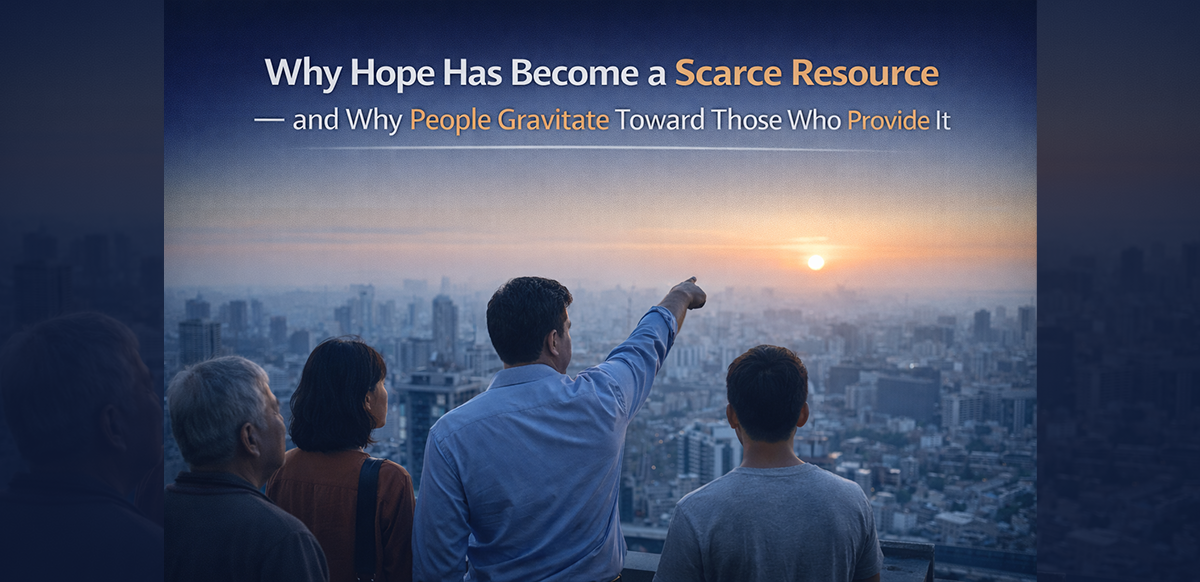
In difficult markets, people follow those who can offer realistic hope and direction. Leaders and agents create value by helping others see a workable path forward.
Most people are not lazy. Most people are lost.
They work hard, follow rules, and do what society tells them to do—yet they feel increasingly powerless inside systems they did not design and cannot control. In a maturing Malaysia, where the median age has hit 31.3 and the Total Fertility Rate has slipped to 1.6, the "Double Squeeze" is real. People are supporting aging parents while realizing that their own career and housing milestones are being pushed further out of reach.
Rising costs and capped incomes have created a quiet crisis: people sense that effort alone is no longer enough. When effort loses direction, it loses meaning. And when meaning disappears, hope evaporates.
Hope is often mistaken for positivity. It is not. Hope is the belief that there is still a path forward that makes sense.
When people lose hope, they don't stop working; they stop planning. They drift. They stay in survival mode because no alternative feels safe enough to try. Hope returns only when someone can stand in the fog and say: "Here is a path that still works—even if life is imperfect."
Modern systems reward specialization but punish deviation. A 9–5 worker knows their income is capped and their time is finite. They aren't unwilling to change; they are afraid of stepping into chaos.
What they need is not motivation. They need a believable exit that does not require burning the bridge behind them. That is the highest form of hope: controlled optionality.
Career shifts—becoming an agent, starting a business, changing direction—are not attractive because they are glamorous. They are attractive because they remove the ceiling.
But unlimited upside without a map is just anxiety. People don't need to be told, "You can earn more." They need to be shown:
They don't follow those who promise outcomes. They follow those who can map transitions.
Buyers don't buy property just for shelter. They buy it because they hope it stabilizes their future and protects their children's options.
Many Malaysian buyers are trapped between rising prices and the fear of making a long-term mistake. They don't lack intelligence; they lack confidence that today's decision won't destroy tomorrow's choices. Property becomes hope because it:
Direction without hope feels mechanical. Hope without direction feels dangerous. People don't follow hype or pressure; they follow those who can say:
"Here is a path that respects reality—and still gives you a future."
The next time a client or a recruit expresses fear, don't counter with data. Don't tell them the market is "booming." Ask them: "What does a safe path forward look like to you?" Your job is not to sell them a product, but to build the bridge that gets them to that safety.
Most people already know they are stuck. What they don't know is whether effort still matters or if the system can be navigated rather than simply endured.
Hope answers that question—not with fantasy, but with structure. The leaders who matter most now are those who can stand calmly inside a broken system and say:
That is not sales. That is leadership. And in times like these, leadership is simply the ability to offer a believable future.

Founder of ListingMine and author of Agent for Life. Building ERP for Malaysian real estate agencies since 2008 — and writing to reshape how agencies grow.
More about Marvin Foong →More articles in this topic