Malaysia does not need to copy MLS if it builds cooperation infrastructure suited to local behaviour. ACN may let the industry leapfrog into a more practical model.
When property leaders talk about fixing the fragmented Malaysian real estate industry, the same idea always resurfaces: "Malaysia needs a central MLS." This sounds logical on the surface, but it ignores the fundamental structural mismatch between the Western MLS model and the modern Malaysian reality. Malaysia does not need to replicate another market's 50-year-old infrastructure; it needs to leapfrog it.
Structurally, Malaysia is not an MLS market. Trying to force one is like trying to install a legacy landline network in an era of 5G satellite data.
A Multiple Listing Service (MLS) is not just a database. It is a social and institutional contract built on assumptions that simply do not hold in Malaysia:
The Malaysian property sector is defined by specific pressures that a central MLS cannot solve:
The problem isn't that Malaysia lacks coordination. The problem is that coordination exists informally via WhatsApp and private networks, without the infrastructure to scale it.
An Agent Cooperation Network (ACN) fits Malaysia because it matches how people actually work. It doesn't assume stability; it assumes movement.
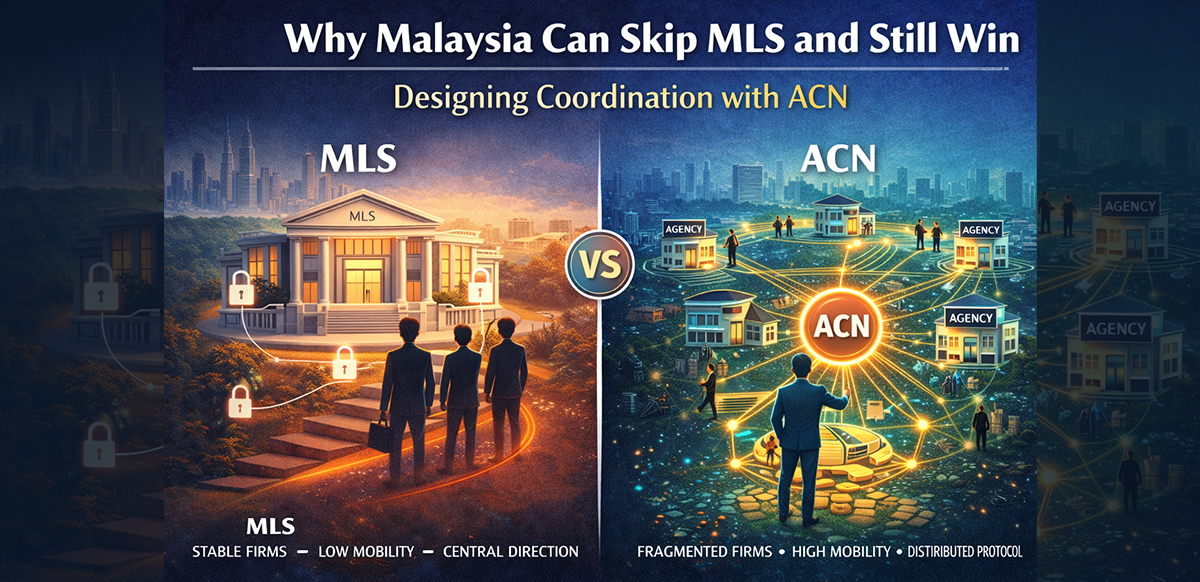
MLS is an Institution: It requires membership, committees, and top-down mandates.
ACN is a Protocol: It requires participation. It is the "HTTP" of property transactions.
You don't "join" an ACN in the sense of a trade association. You operate on it. It provides the rules for cooperation, protection for contributions, and settlement for outcomes—regardless of which agency an agent moves to.
Instead of a single, rigid database that everyone must feed, ACN works as distributed rails embedded directly into the tools agents already use (ERPs, CRMs, and Transaction Apps).
By skipping the centralized MLS and building distributed ACN rails, Malaysia gains a massive strategic advantage:
Malaysia has the opportunity to avoid the "Institutional Trap" of the West. Centralized databases consolidate power; distributed protocols compound value. The winning architecture for 2026 and beyond will not be the one that is the "most official." It will be the one that fits how Malaysian agents actually work.
And in Malaysia, that architecture is ACN.

Founder of ListingMine and author of Agent for Life. Building ERP for Malaysian real estate agencies since 2008 — and writing to reshape how agencies grow.
More about Marvin Foong →More articles in this topic
This article is one of the sources behind this assessment. Take it to see what you already know and what to read next.
Educational self-assessment. Not a licensing examination or professional certification.