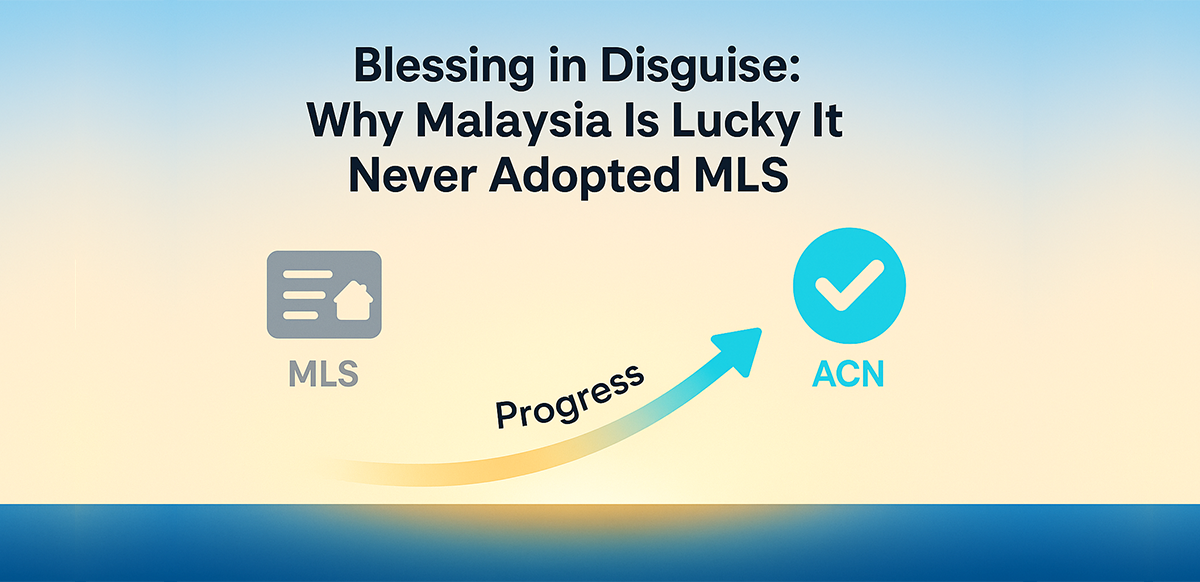
Malaysia’s lack of MLS may become an advantage because the country can build a model better suited to local agency behaviour. ACN can evolve around cooperation, roles, and traceability instead of copying foreign systems.
ListingMine Academy | Real Estate System Design
Malaysia didn’t “fail” to adopt MLS.
Malaysia avoided being trapped by MLS.
What looked like a weakness in the 2000s has become one of the country’s greatest structural advantages today — because Malaysia leapfrogged straight into the verification era without inheriting the baggage of visibility-era infrastructure.
This is the full logic.
Over the years, many leaders, associations, and private groups attempted to introduce MLS-style platforms into Malaysia. These efforts were:
And at the time, they made sense.
Malaysia then suffered from:
In that context, MLS looked progressive — and those who championed it were early visionaries.
But Malaysia eventually outgrew the very problem MLS was designed to solve.
In 2005–2015, the bottleneck was visibility.
MLS solved visibility brilliantly.
But in 2025, visibility is everywhere:
Buyers no longer struggle to find listings.
They struggle to trust them.
Malaysia’s real bottlenecks today are:
MLS was never designed for verification.
It was designed for publication, not proof.
And if Malaysia had adopted MLS as national infrastructure, the entire industry would now be trapped in a visibility-centric model during a verification-centric era.
| Era | Main Problem | Required Infrastructure |
|---|---|---|
| 2005–2015 | Visibility | MLS, portals |
| 2020–2030 | Verification | ACN, proof-of-work systems |
Visibility is solved.
Verification creates value.
Because MLS never became Malaysia’s backbone, the market avoided:
Other countries inherited constraints.
Malaysia inherited optionality.
This rare structural freedom allows Malaysia to design a cooperation standard for today’s needs, not for yesterday’s problems.
Most countries must reform MLS.
Malaysia can skip MLS entirely.
This is a generational leapfrog moment.
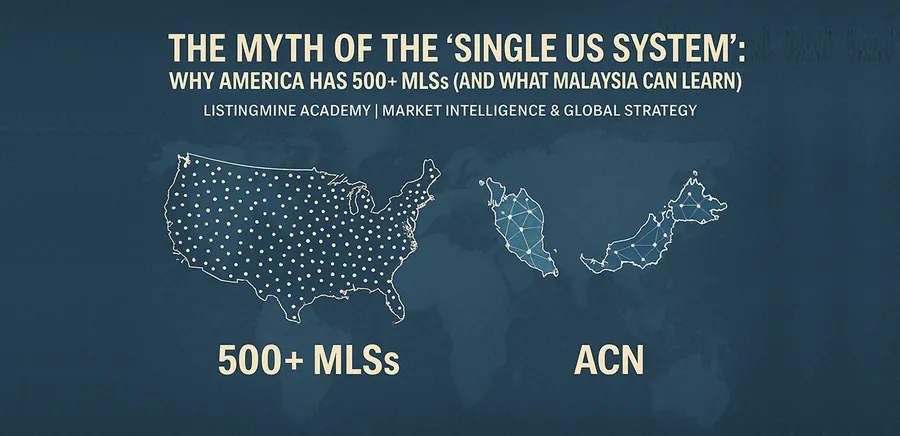
The Agent Cooperation Network (ACN) is not theory.
It is a real operating system proven at massive scale by Beike (KE Holdings Inc.) in China, powering hundreds of billions in annual transaction value.
Beike pioneered:
Important clarification:
Lianjia = an agency
Beike = a neutral ACN platform connecting many agencies
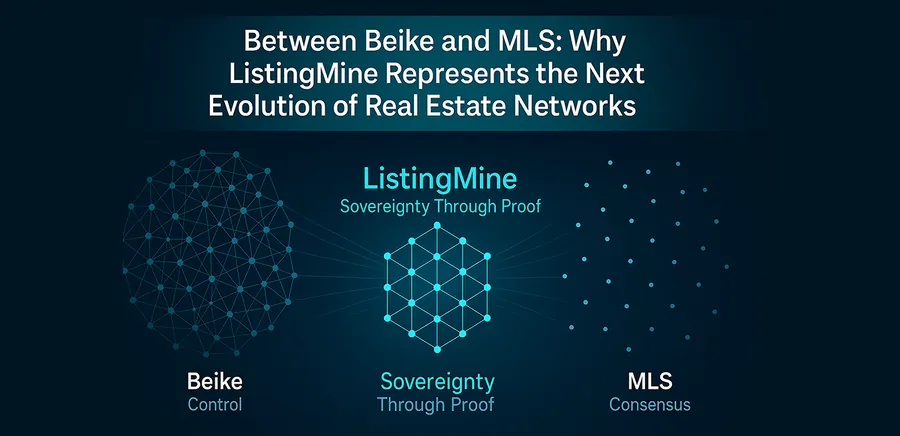
But even Beike’s ACN sits on agency-centric foundations shaped by China’s legacy structures.
Malaysia can surpass this.
ListingMine is designed for a purer, more flexible, fully distributed ACN, where:
As more agencies deploy their ACNs through ListingMine, Malaysia will naturally converge into:
A bottom-up National ACN standard — the first of its kind in Asia.
Modern MLS vendors may offer:
Cleaner UI
Better APIs
Updated integrations
But none of these change the foundation.
You cannot evolve a visibility tool into a verification engine.
The architectures are incompatible.
| Category | MLS Limitation | ACN Strength |
|---|---|---|
| System Logic | Listing-centric | Transaction-centric |
| Role Structure | 2 roles | 8–12+ roles |
| Agent Model | Super-agent assumption | Specialist-based |
| Verification | Minimal | Proof-of-work |
| Governance | Committees | Automated rules |
| Incentives | Salary-based checkers | Success-based verifiers |
| Funding | Subscription | Transactional |
| Scalability | Region/association | Nationwide |
Architecture is destiny.
APIs cannot patch destiny.
Example: Appointment Letter Verification
Ask any MLS operator:
“Do you verify the appointment letter before publishing a listing?”
If no → trust collapses.
If yes, ask:
“Is your verifier paid per deal or on a fixed salary?”
A salary-based verifier:
Has no economic incentive
Faces no consequence for negligence
Cannot ensure high-trust verification
Verification without aligned incentives is performative, not reliable.
This is why MLS cannot become ACN.
Today’s agent must be:
One person cannot survive the rising complexity.
MLS only recognises two roles.
ACN supports specialisation across 8–12+ roles.
When workload multiplies, specialisation becomes survival.
And only ACN supports that evolution.
A true ACN requires:
Without governance, ACN becomes politics.
With governance, ACN becomes physics.
ListingMine provides the governance layer, enabling every agency to design:
Agencies that adopt early become:
These early adopters form the backbone of Malaysia’s future National ACN.
If MLS had succeeded, Malaysia today would be locked into:
Introducing ACN would be mathematically impossible.
But because MLS did not take root:
Malaysia didn’t lose MLS.
Malaysia preserved the freedom to build something better.
Path dependence did not trap Malaysia — it liberated Malaysia.
Malaysia never adopted MLS.
And that “failure” is now a strategic advantage.
The country can build a next-generation cooperation model:
ACN is not the alternative to MLS.
ACN is the upgrade MLS cannot evolve into.
And Malaysia is uniquely positioned to build the world’s first truly distributed ACN ecosystem.
If you want to understand how Malaysia’s real estate industry will truly reform, explore the full library at ListingMine Academy.
Every article is original writing by the ListingMine founder, built on:
You will learn how to:
When you’re ready, create your ListingMine account and follow the built-in steps to launch your agency’s ERP:
No consultants
No manual configuration
No custom coding
No theory
Just a system that works — and grows with you.

Founder of ListingMine and author of Agent for Life. Building ERP for Malaysian real estate agencies since 2008 — and writing to reshape how agencies grow.
More about Marvin Foong →More articles in this topic
This article is one of the sources behind this assessment. Take it to see what you already know and what to read next.
Educational self-assessment. Not a licensing examination or professional certification.