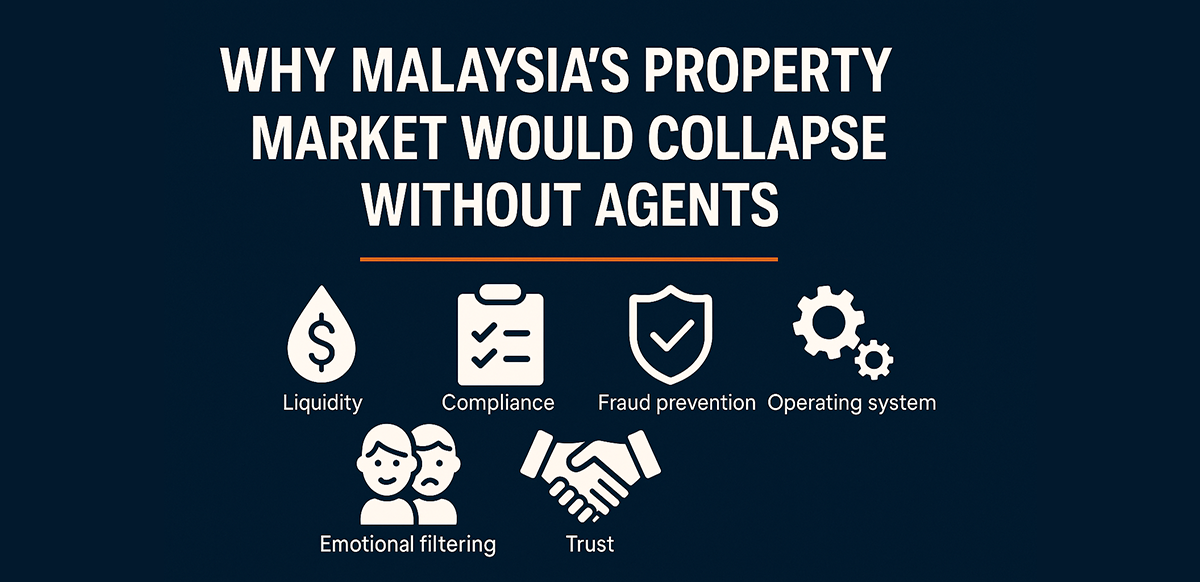
Agents provide liquidity, matching, negotiation, education, and transaction coordination. Without agents, many buyers, sellers, and developers would struggle to move property efficiently.
A structural diagnosis of why agents are not middlemen, but the operating system of real estate.
Most Malaysians assume property agents are optional. Some believe technology can replace them. Others think commissions are too high for the value provided. But this interpretation ignores the structural truth:
Remove agents from the ecosystem, and Malaysia’s property market slows, fragments, becomes unsafe, and eventually collapses.
Agents are not decorative. They are the decentralized architecture that keeps liquidity, trust, compliance, and mobility alive in a low-transparency, high-stakes, emotionally volatile market. They are not the problem. They are the load-bearing layer.
Malaysia’s property data is delayed and fragmented:
Agents provide real-time pricing signals from the ground, narrowing the gap between expectation and reality.
Global proof: In markets where agent usage dropped (e.g., parts of New Zealand post-2020), days-on-market rose 40–60% and bid–ask spreads widened sharply. When the agent layer weakens, the market literally slows down.
A single Malaysian property transaction involves 15–20 discrete steps, including:
If Malaysians had to self-learn the National Land Code and strata law for every transaction, economic productivity would collapse. Agents function as project managers for society, reducing:
Vacant units and overhang represent dead capital.
Agents activate dormant assets by:
They transform idle units into:
This boosts national capital efficiency.
Real estate involves emotion, money, risk, and legal complexity. Agents prevent the ecosystem from collapsing under this pressure.
Agents detect issues before lawyers even enter the picture:
They act as the first line of fraud defence. A weak agent layer = higher national fraud risk.
Emotion destroys deals faster than price. Classic Malaysian example: “I’ve seen deals die because the seller’s mother said the buyer’s offer had ‘no blessing.’”
But the agent translates it into: “Seller counters at RM1.05 mil with 3-month completion.”
Deal closes. Agents convert irrational emotion → rational terms.
Without them, the majority of deals involving family influence, ego, cultural expectations, or pride would collapse.
Refined insight:
“The government cannot inspect every booking form. The agent is the only person in the room with the legal obligation to ensure the law is followed before the lawyers get involved.”
Agents serve as deputized compliance officers who enforce:
They are the street-level bureaucrats of real estate. Without them, enforcement collapses, scams rise, and public trust disintegrates.
For most Malaysians, property is their main wealth-building tool. Agents guide households through:
Agents are often the public’s first exposure to financial literacy.
Agents resolve disputes quietly and efficiently:
Most of these cases never reach lawyers because the agent resolves them. This conserves public resources and reduces strain on the legal system.
Agents influence neighbourhood stability by:
They function as informal gatekeepers of community harmony.
Malaysia runs on a dual structure:
Even with 30,000 RENs, this is still one of Malaysia’s largest doorstep salesforces, bigger than many regulated sectors.
The paradox: The system depends entirely on agents — yet society undervalues and distrusts them. This distrust suppresses the potential of the entire market.
Transition sentence: Addressing this trust deficit is not about bypassing agents, but about leveraging and upgrading the layer they represent.
A re-architected market requires:
In this future, agents evolve into:
Portals cannot replace this. The government cannot replicate it. Only agents can carry it.
| Layer | Core Value Provided | Failure Mode if Agents Are Weak |
|---|---|---|
| Economic | Liquidity, price discovery, efficiency | Market stagnation, pricing bubbles |
| Systemic | Fraud prevention, compliance, enforcement | Scams, illegal brokerage, collapse of trust |
| Social | Conflict resolution, mobility, literacy | Misinformation, neighbourhood instability |
| Political | Stable property tax base, orderly development | Illegal subdivisions, tax leakage |
Property agents are not middlemen. They are the stabilisers, interpreters, buffers, verifiers, educators, and compliance guards of a system that relies on human interaction and legal certainty.
You can dislike the commission. You can debate their professionalism. You can criticize their inconsistencies.But the reality is unambiguous:
In Malaysia, you can hate the commission — but you cannot survive without the layer that earns it.

Founder of ListingMine and author of Agent for Life. Building ERP for Malaysian real estate agencies since 2008 — and writing to reshape how agencies grow.
More about Marvin Foong →More articles in this topic
This article is one of the sources behind this assessment. Take it to see what you already know and what to read next.
Educational self-assessment. Not a licensing examination or professional certification.