Bosses often blame agent character when the structure itself creates bad outcomes. System design explains many problems better than moral judgment.
When an agency begins to stall, the friction is unmistakable. Principals feel it as missed targets, heated arguments, empty desks, and teams that quietly stop cooperating.
But without training in system design, the human brain defaults to the most available explanation: Personality.
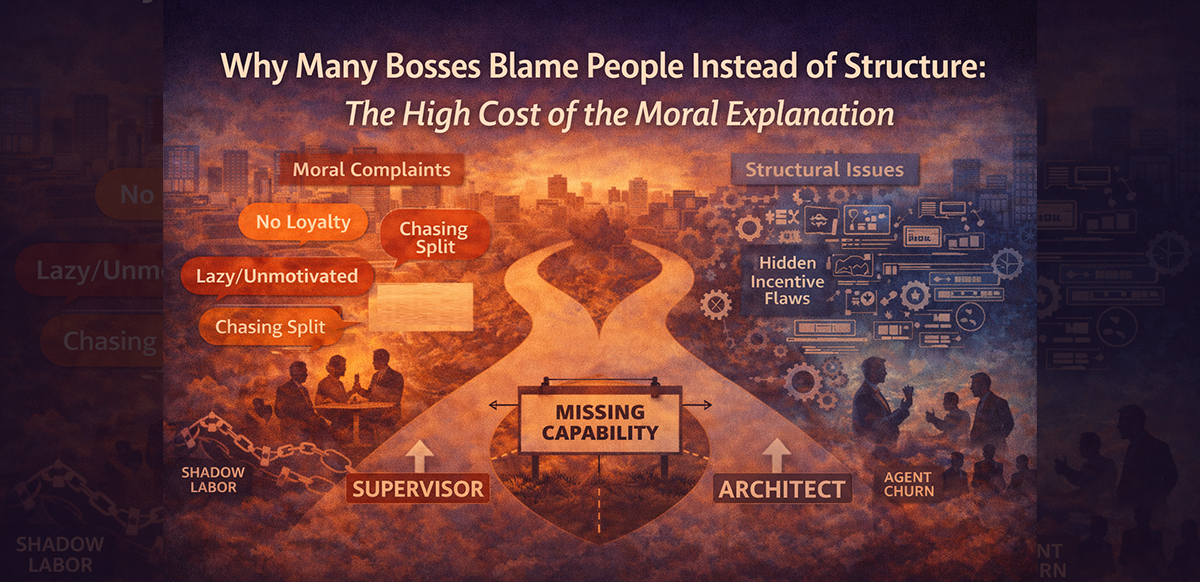
You hear it everywhere:
These are moral explanations for mechanical failures. They feel true because they focus on visible behavior. But for an agency principal, blaming people is a strategic dead end.
You cannot fix a generation. You can redesign a structure.
In psychology, this is known as the Fundamental Attribution Error: the tendency to overemphasize character and underemphasize the environment.
In a property agency, structure is invisible. You cannot see incentive misalignment, flawed attribution logic, or weak retention economics. You only see the outcome: an agent leaving, two team leaders fighting, or a deal exploding at payout.
Because the structure is invisible, the behavior is blamed. When a principal lacks the language of system design, they are forced to use the language of character.
They diagnose a faulty engine as a bad driver.
The first step in re-architecting an agency is translation. Not solving—translating. This moves the problem from the realm of judgment to the realm of engineering.
| Moral Complaint (People) | Structural Diagnosis (System) |
|---|---|
| "They have no loyalty." | "The switching cost is low and long-term equity is undefined." |
| "They're lazy or unmotivated." | "The effort-to-payout feedback loop is too long or opaque." |
| "They only care about the split." | "The agency provides no network effect beyond a desk." |
| "They keep disputing commissions." | "Attribution logic is verbal or manual, leaving room for interpretation." |
Blaming people is not just inaccurate; it is capital-inefficient. If you believe the problem is loyalty, your only tools are inspiration, filtering for "better attitudes," and personal intervention.
This creates emotional labor, founder burnout, and a business that scales only as far as your charisma can reach. That is not leadership. That is dependency.
When you believe the problem is structure, the solution changes completely.
You don't ask for loyalty; you design retention economics.
You don't ask for hard work; you design incentive alignment.
You don't ask for fairness; you design immutable logic.
Morality persuades. Mechanics enforce.
Most principals misdiagnose these problems for one simple reason: Their education trained them to supervise people, not to design systems.
So they keep asking: "What is wrong with my people?" Instead of the only question that scales: "What behavior is my current structure accidentally rewarding?"
They are studying the players, while the game itself is misconfigured.
The shift from boss to architect happens at a precise moment: When you stop managing personalities and start designing outcomes. This is not about being less human; it is about being less personal. Once behavior is shaped by structure, you no longer need to police character.
ListingMine Academy exists to provide the vocabulary for this shift. We don't talk about "motivation"—because motivation fluctuates. We talk about commission architecture—because architecture endures.
Once a structure can be named, it can be controlled. Until then, you are hostage to personalities you cannot scale.

Founder of ListingMine and author of Agent for Life. Building ERP for Malaysian real estate agencies since 2008 — and writing to reshape how agencies grow.
More about Marvin Foong →More articles in this topic
This article is one of the sources behind this assessment. Take it to see what you already know and what to read next.
Educational self-assessment. Not a licensing examination or professional certification.