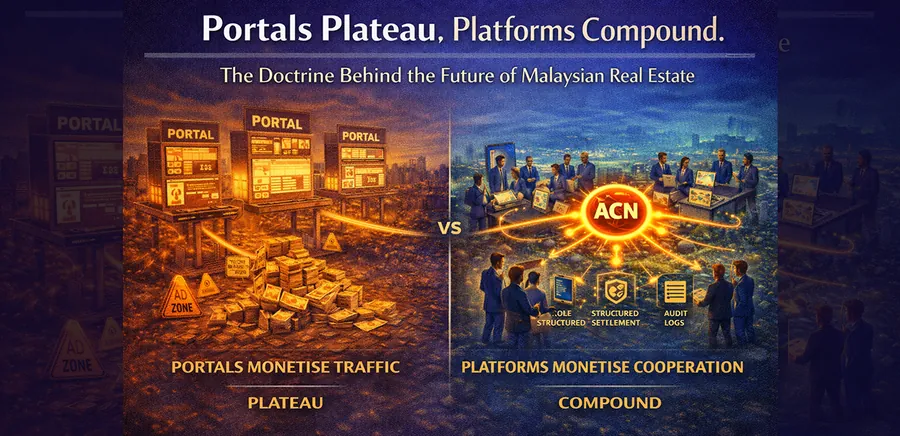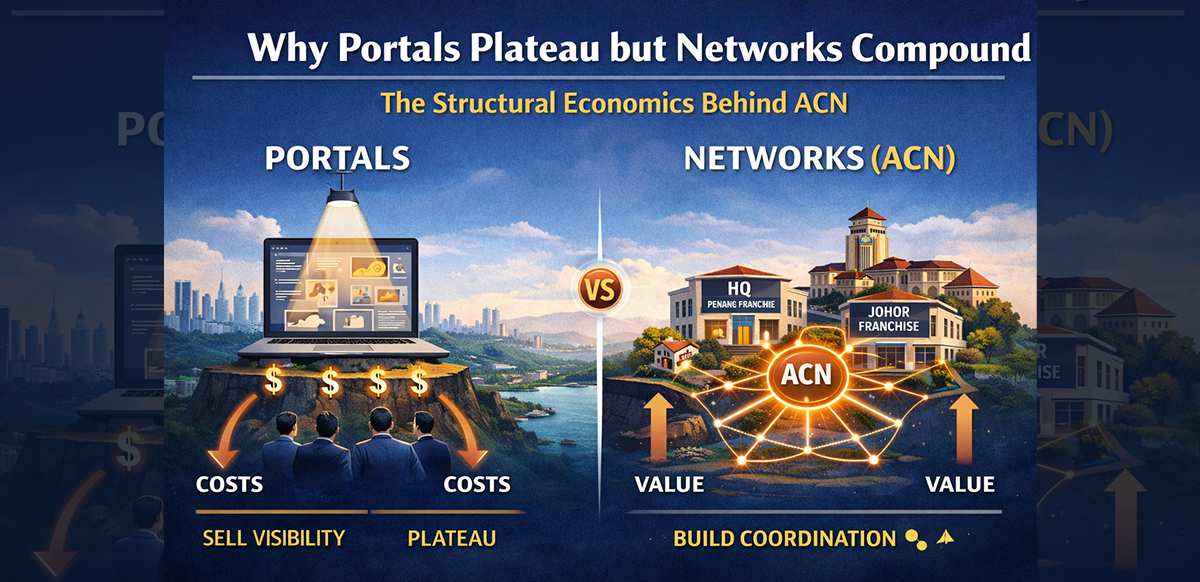
Portals plateau because they mainly aggregate listings, while networks compound through trust, cooperation, data, and repeated transactions. ACN creates stronger long-term economics than pure exposure.
Most people in real estate think portals are powerful because they are visible. They are wrong. Portals are powerful because they control attention—and attention is a finite resource.
That single fact explains why portals inevitably plateau, and why coordination networks (ACN) compound.
Portals monetise visibility. Visibility is a zero-sum game. Only one person can be "number one" on a search result.
ACN monetises coordination. Coordination is a positive-sum system. The more people who coordinate, the more "surface area" there is for every participant to close a deal.
ACN is not a marketing upgrade; it is an economic upgrade.
Portals do not sell demand; they sell priority in a crowded space. Their economic model depends on three conditions:
As more agents join a portal, each agent must pay more just to stand still. This is not growth; it is rent extraction.
Portals scale revenue by increasing agent counts or price-per-lead. But they do not increase transaction efficiency. In fact, as portals grow:
They cannot compound value; they can only re-auction the same visibility.
An Agent Cooperation Network (ACN) does not sell attention. It settles cooperation. Its value comes from enabling:
In economic terms, ACN internalises transactions that would otherwise be lost, duplicated, or disputed. This is market efficiency.
ACN monetises two things portals cannot:
Once trust and settlement exist, cooperation scales without negotiation. That is the beginning of compounding.
Here is the uncomfortable truth for the Malaysian property agent:
This is why senior operators eventually feel trapped by portals and are attracted to coordination systems—they realize they are working for the platform, rather than the platform working for them.
Every new participant in a portal competes with existing users and raises costs. Every new participant in an ACN adds listings and buyers, increasing liquidity for everyone.
That is the definition of a positive-sum network. At scale:
Portals will always exist because they are efficient at selling attention. But attention does not compound.
Coordination does.
That is why portals plateau and why networks—once they reach critical mass—become infrastructure. You don't compete with infrastructure. You either build it early or you connect to it later.
And late connection is never cheap.

Founder of ListingMine and author of Agent for Life. Building ERP for Malaysian real estate agencies since 2008 — and writing to reshape how agencies grow.
More about Marvin Foong →More articles in this topic
This article is one of the sources behind this assessment. Take it to see what you already know and what to read next.
Educational self-assessment. Not a licensing examination or professional certification.