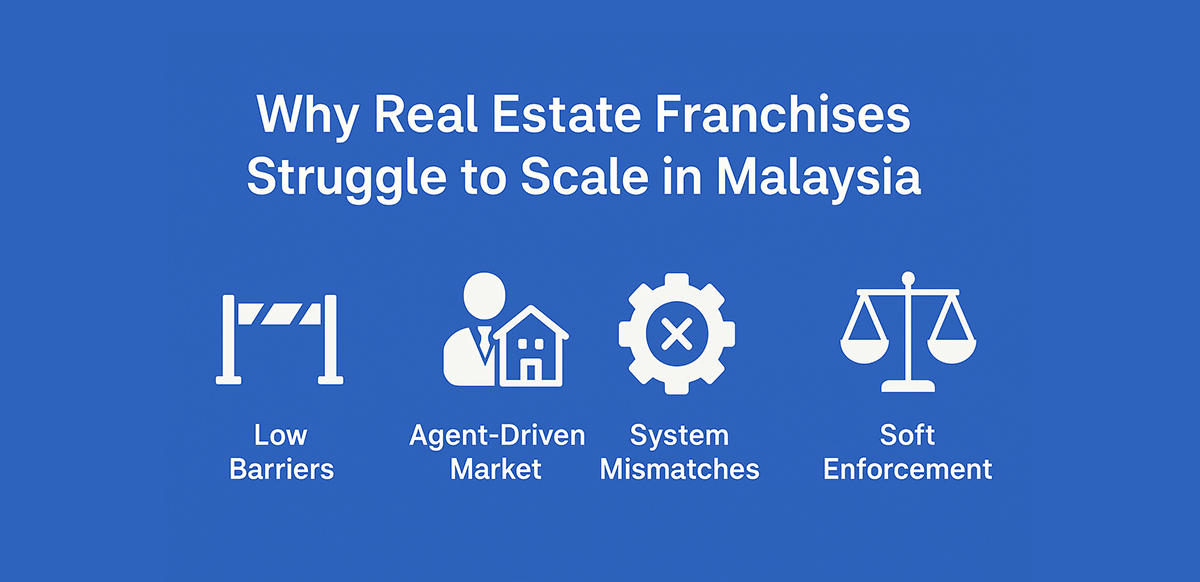
Real estate franchises struggle when the model does not fit local agent behaviour, cost structure, leadership style, and market culture. Franchise branding alone is not enough.
Everywhere else, the franchise model is the blueprint of real estate success.
In Malaysia, it's still an unanswered experiment.
From RE/MAX to Century 21, franchises thrive in developed markets because they deliver structure, compliance, and credibility — things independent agents can't easily build.
But in Malaysia, despite years of effort, the model has never truly taken off.
And the reason isn't that Malaysians reject structure — it's that the current system actively rewards entrepreneurial informality.
Starting a property agency in Malaysia is remarkably easy compared to developed markets.
Technically, one REA (Registered Estate Agent) may supervise up to 50 RENs (Real Estate Negotiators). In practice, enforcement is mostly reactive — authorities step in only when complaints arise.
This light-touch environment lets agencies grow faster than regulations can catch up. The point isn't that firms ignore the law — it's that the enforcement culture remains developmental, allowing entrepreneurship to flourish unchecked.
"In Malaysia, boundaries exist — but until they're actively enforced, growth naturally pushes them."
In developed markets, brand credibility drives sales. Consumers recognise names like ERA or Keller Williams — and that recognition builds trust.
In Malaysia, property deals are personal, not institutional. Buyers and landlords care more about the agent than the agency. People choose "Jason, who helped my cousin," not "XYZ Realty."
That dynamic erases much of a franchise's advantage. A global logo doesn't move listings when relationships are agent-driven.
There is one exception — corporate agencies. Global firms like CBRE, Knight Frank, and JLL succeed because they manage institutional portfolios and foreign mandates. Their brand matters when clients are corporations, not individuals.
But when both buyer and seller are Malaysian, brand equity fades. Retail agency work demands speed, relationships, and local improvisation — the opposite of a corporate playbook.
"They win in the market for institutions — but lose in the market of individuals."
"In Malaysia, the brand doesn't sell the property — the agent does."
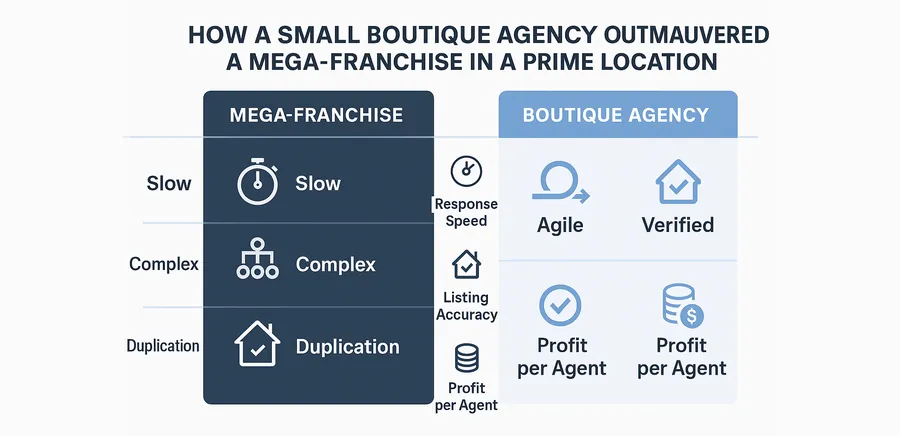
Several international franchises have entered Malaysia, yet most underperform — not because of marketing, but because their systems aren't built for our market.
Their technology and workflows assume uniform rules and predictable compliance. Malaysia's property landscape is fragmented, fluid, and relationship-based.
Common mismatches include:
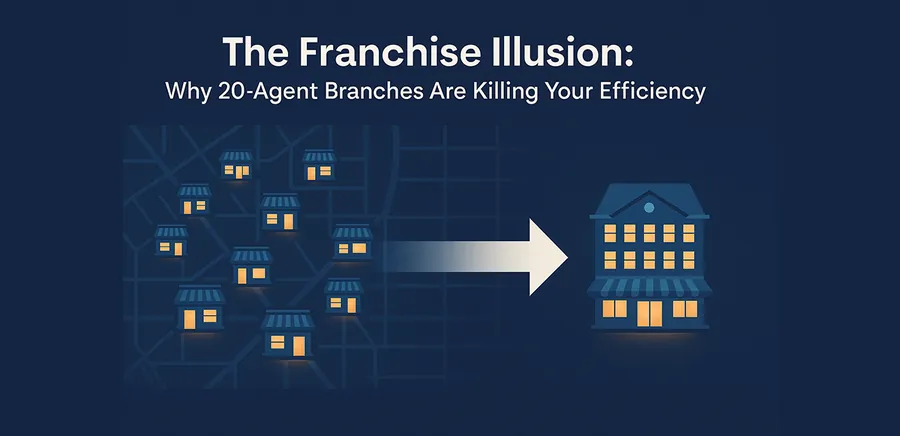
It's more than a software issue — it's a cultural one. Their model depends on high-visibility streetfront offices, a concept that collapses in Malaysia's digital-first, WhatsApp-driven ecosystem.
"What works on Main Street, USA doesn't work on Jalan Damansara.
The signage survives — the system doesn't."
Local franchises face redundancy, not resistance.
A determined REA or team leader can already:
Many agencies already pay near-100% commission splits to attract talent. Why would they give up another 7–10% in franchise fees — especially when the franchisor offers no exclusive tech or compliance advantage?
Without a proprietary system or clear efficiency gain, most local franchises offer only a name. And that's not enough in a market where independence equals status.
"Malaysian agency leaders don't want to be managed — they want to multiply."
Malaysia's real-estate sector runs on soft enforcement. Laws exist — and penalties are real — but monitoring is reactive. As long as firms avoid complaints, they enjoy wide operational freedom.
In markets with strict audits, a franchise is a survival tool. In Malaysia, it's viewed as unnecessary overhead — a solution to a problem that doesn't yet feel urgent.
"Franchises feel unnecessary in a free market — until the day freedom ends."
But regulation always catches up — and when it does, systems win over personalities.
Franchising will eventually thrive in Malaysia, but not because of branding. It will succeed when compliance becomes non-optional.
Picture this future:
When that happens, compliance becomes a full-time discipline. Smaller firms will seek protection under structured networks. That's when franchising will finally make sense — not as a logo, but as infrastructure.
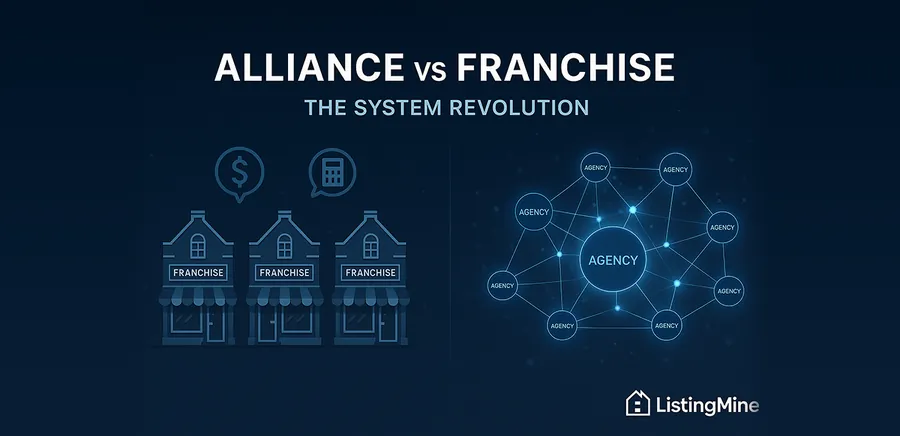
The next generation of growth in Malaysia won't come from traditional franchising — it will come from system-driven alliances.
That's exactly what ListingMine was built for.
It's Locally Adapted: Built for Malaysia's realities — multi-tier overrides, project sales, and co-broking — the same complexities foreign systems fail to handle.
It's a Proprietary Advantage: Provides the ERP backbone that local leaders can't build themselves — giving them a reason to connect, not compete.
It Enables Alliances: Through the Alliance ACN, independent brands can share listings, unify compliance (PDPA, AMLA, audit trails), and still keep their brand, ownership, and payout control.
It's collaboration without surrender — the bridge between today's free-form chaos and tomorrow's regulated ecosystem. This isn't the end of franchising — it's the evolution of it.
Malaysia's flexible laws and entrepreneurial spirit make it the easiest country in Asia to start an agency. That same freedom has delayed franchising — but it's also created an unmatched opportunity for brand builders.
When compliance tightens, those already operating with structure and verifiable systems will scale effortlessly. Those still relying on improvisation will scramble to catch up.
"Franchises will rise again — not through logos, but through systems.
Until that day, Malaysia remains the best country in the world to build your own brand — while you still can."

Founder of ListingMine and author of Agent for Life. Building ERP for Malaysian real estate agencies since 2008 — and writing to reshape how agencies grow.
More about Marvin Foong →More articles in this topic
This article is one of the sources behind this assessment. Take it to see what you already know and what to read next.
Educational self-assessment. Not a licensing examination or professional certification.