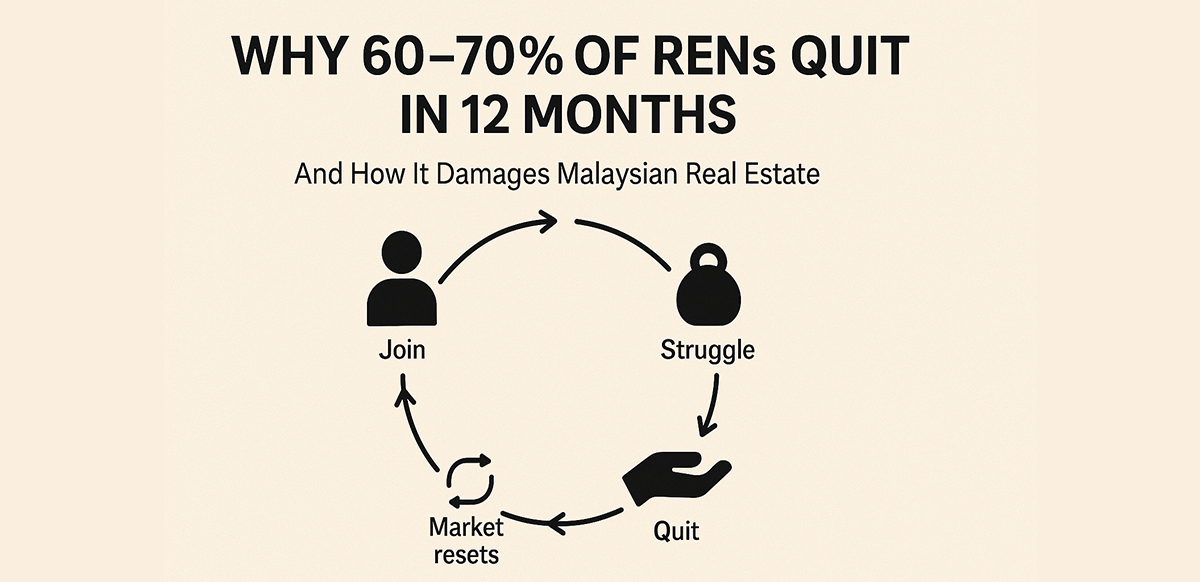
High REN dropout damages agency stability, training ROI, client service, and industry professionalism. The problem reflects weak onboarding, income pressure, and lack of survival infrastructure.
Every year, thousands of Malaysians enter the real estate industry with a REN tag. And every year, the majority quietly disappear within their first 12 months.
The REN layer is enormous — far larger than the number of licensed REAs supervising them — but the half-life of a new negotiator remains brutally short. This churn is not caused by laziness, mindset, or poor character. It is engineered into the structure.
Becoming a REN is easy:
This attracts many newcomers who believe real estate is a quick way to earn commission income. But surviving the first year requires more than determination.
1.1 Zero Basic Pay
RENs start with no salary, no allowance, and no financial buffer.
1.2 Delayed Payout Cycles
Even when a REN successfully finds a buyer:
Income comes long after the work is done.
1.3 The Cashflow Mismatch
A new REN faces:
All before earning a single ringgit.
And the sentence that defines the churn problem is this:
Most don't quit because they cannot sell. They quit because the business model requires a financial runway they don't have.
This is the economic truth behind the churn.
The common misconception is: “New RENs fail because they don't have listings.” In reality, Malaysia's market has:
New RENs end up spending endless hours:
This leads to a high workload but low conversion — long before any income arrives.
When months pass with no commission, a REN enters the danger zone. This is when “survival behaviours” show up:
These behaviours do not reflect bad values. They reflect financial pressure. The public meets RENs in their most desperate months — which is why the entire profession suffers reputational damage.
Here is the hidden crisis almost no one talks about: When a REN quits, the client relationship often disappears with them. Most RENs store everything on their personal devices:
So when a REN suddenly leaves the industry, clients experience:
“My agent disappeared.”
One REA shared a real case:
“When Ah Meng quit, my buyer Mr. Tan called me and said, 'your agent disappeared with my loan documents'.”
This is not rare. It is systemic. Because the industry relies on personal memory instead of system memory, client continuity breaks the moment a REN walks away.
5.1 Trust Erodes
Clients don't know whether the agent they meet will still be around next month.
5.2 Knowledge Is Lost
Every time a REN quits, the agency loses:
This resets progress repeatedly.
5.3 Agency Operations Become Unstable
Teams constantly rebuild from zero.
5.4 Market Efficiency Drops
Momentum collapses when negotiators leave mid-transaction.
Malaysia's property ecosystem still relies on:
This is fragile and temporary. When most RENs statistically leave within their first year, the system collapses repeatedly because the data leaves with them. The problem is structural, not personal.
Verified inventory and verified documentation must be executed by agencies and REAs — not platforms.
ListingMine's role is simply to provide the infrastructure that agencies need to enforce:
It is infrastructure, not a magic wand.
Agencies must still enforce discipline and verification.
Once the infrastructure is in place:
This is how churn becomes survivable.
Malaysia's high REN churn rate is not a sign of weak individuals. It is the predictable outcome of:
The real path to professionalisation is not to wish for stronger RENs.
Professionalisation begins the day client relationships and listing memory no longer vanish every time a negotiator walks out the door.

Founder of ListingMine and author of Agent for Life. Building ERP for Malaysian real estate agencies since 2008 — and writing to reshape how agencies grow.
More about Marvin Foong →More articles in this topic
This article is one of the sources behind this assessment. Take it to see what you already know and what to read next.
Educational self-assessment. Not a licensing examination or professional certification.