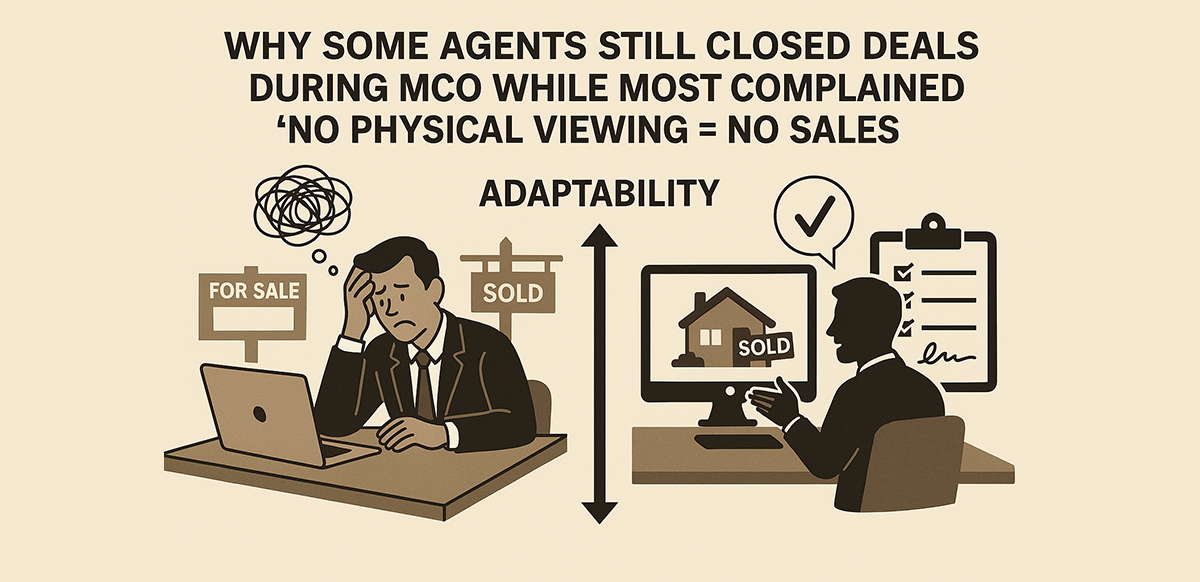
Some agents succeeded during MCO because they had stronger relationships, digital habits, buyer trust, and follow-up systems. Crisis exposed the difference between prepared agents and reactive agents.
When the MCO hit, the entire real estate industry was forced into a sudden digital stress test.
Physical viewing stopped.
Movement stopped.
Walk-ins stopped.
Open houses stopped.
Most agents immediately concluded the same thing: "No physical activity = no sales."
And for the majority, that was true — their income went to zero. But a small minority of agents defied the trend. They closed deals via Zoom, through digital booking, with online document submission, virtual tours, and remote negotiation. These were not the lucky few. These were the few who were prepared. The question is:
If others could close deals online during MCO, why couldn't you?
Something must be wrong — and it was.
Below is the structural breakdown of why the top performers weren't you.
The traditional agent depended entirely on a physical, sequential workflow:
Walk-in → Viewing → Office discussion → Signing
MCO shattered all four steps.
Meanwhile, top performers had already digitized the entire client journey before MCO even happened.
| Stage | Traditional Agent | Top Performer |
|---|---|---|
| Discovery | Waited for property portals, signboards, referrals | Ran SEO, targeted ads, investment webinars, niche buyer funnels |
| Viewing | Needed physical viewing to "sell the feel" | 360° tours, Matterport scans, WhatsApp walkthroughs, drone videos |
| Decision | Needed face-to-face persuasion | Zoom consultations, digital presentations, virtual comparisons |
| Closing | Needed physical signatures | Online booking, e-signatures (for allowed documents), solicitor-assisted digital conveyancing |
What the majority lost, the minority had already replaced.
Most agents' persuasion ability relied heavily on:
When all that disappeared, so did their confidence and closing ability. Top performers relied on verbal precision, data, visual tools, and digital trust-building — not on physical presence.
They were already doing these before MCO:
The majority blamed the lockdown. The minority upgraded their skillset.
This is the most painful truth.
Top agents closed during MCO because trust was already built long before the lockdown.
When they jumped on Zoom:
For them, Zoom wasn't the first contact — it was the continuation of a long-running digital relationship. Meanwhile, for many agents:
You cannot build trust during a crisis if you never built trust before the crisis.
Most agents failed during MCO not because they lacked skill, but because they lacked systems.
The majority had:
Top performers had:
They weren't improvising. They were executing.
During MCO, you saw a stark contrast:
The Waiting Majority
The Adapting Minority
Adaptability is not talent.
Adaptability is not luck.
Adaptability is practice, systems, and mindset.
The agents who closed deals:
The agents who failed:
The crisis did not create the gap. The crisis exposed the gap.
Here is the integrated truth:
The top agents succeeded online because they were already digital professionals.
You struggled because your business model was never built for a digital environment. The MCO simply revealed:
Top agents didn't win because of MCO. Top agents won despite MCO, because they had already prepared for the next era.
If another lockdown happened tomorrow, would your business continue?
If your honest answer is "no," then your business is not future-proof.
The agents who closed deals during MCO weren't magicians. They were architects who built their business to survive disruption. The majority weren't victims. They were simply unprepared. The next disruption — economic downturn, interest rate shock, regulatory shift, AI disintermediation — is coming. The question is no longer:
"Can deals be closed online?" We already know the answer.
The real question is: Next time, will you be in the complaining majority — or in the minority that eats?

Founder of ListingMine and author of Agent for Life. Building ERP for Malaysian real estate agencies since 2008 — and writing to reshape how agencies grow.
More about Marvin Foong →More articles in this topic