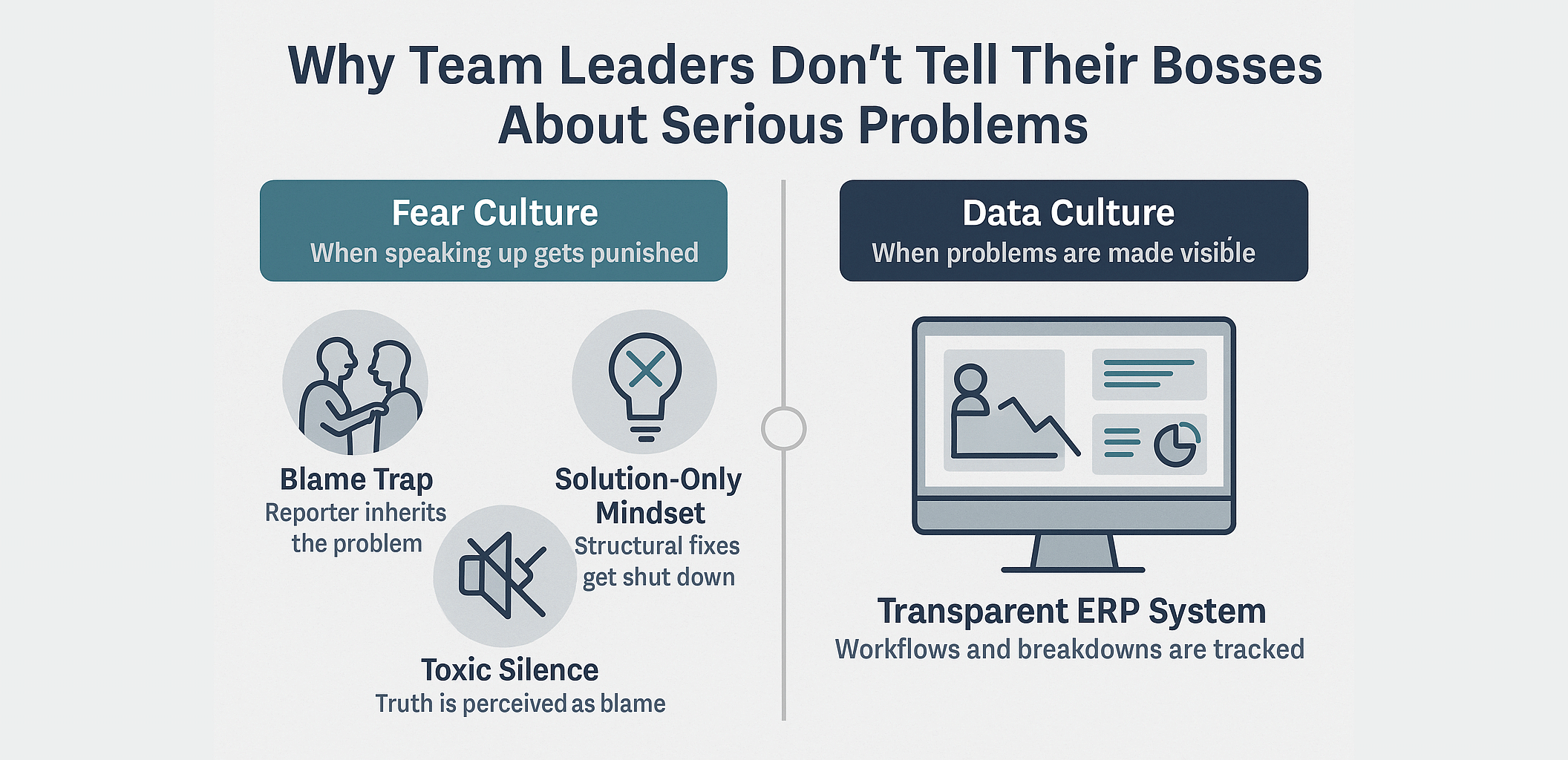
Team leaders may hide serious problems because they fear blame, loss of autonomy, or political consequences. Agencies need trust and reporting systems that surface issues early.
When Speaking Up Becomes a Punishment, Silence Becomes the Agency’s Survival Strategy.
In every real estate agency, critical truths never reach the top. It’s not because leaders are incompetent; it’s because team leaders—the people who see the frontline—have learned that honesty often backfires.
The uncomfortable reality is that most team leaders know exactly what’s broken: slowing sales, weak follow-up, toxic culture, unfair splits. But they stay silent. Not out of fear, but out of experience.
The fastest way to kill initiative is to punish the messenger. In most agencies, the moment a team leader reports an issue, the boss replies: “Since you noticed it, you handle it.”
A team leader might simply want to flag a structural issue—for instance, that agents are losing leads because there’s no functioning CRM. But instead of being heard, they’re handed a new, full-time responsibility on top of their sales target.
Leaders quickly learn a simple, defensive lesson: The less you speak, the less work you inherit. They keep quiet, the system remains broken, and the company mistakes silence for stability.
The common managerial mantra—“Don’t bring me problems, bring me solutions”—sounds wise, but it is deeply counterproductive.
Why? Because not every leader has the authority or budget to fix the system. When a team leader highlights that agents are quitting due to commission disputes or that co-broking fails because there’s no shared data, they aren’t asking for delegation; they’re asking for structural support.
By rejecting the conversation unless it’s fully packaged as a fix, bosses unintentionally send a dangerous message: “If you can’t personally afford to solve it, don’t talk about it.” So, people stop talking.
Some agency principals unconsciously interpret problems as personal attacks.
If a team leader offers honest feedback, such as, “Our current culture is driving talent turnover,” the boss doesn’t hear a diagnosis; they hear: “You failed to manage your team.”
That emotional defensiveness turns honest feedback into career risk. Leaders learn that maintaining harmony and protecting the boss’s ego is safer than telling the truth. The agency then fails not due to lack of information, but due to fragile leadership that punishes transparency.
Sometimes, the team leader knows the problem and the fix, but hesitates to bring it up because it exposes how limited their actual authority is.
It’s easier to tell the team, “Management is handling it,” than to admit, “I’ve been trying to get the CRM fixed for six months, but I can’t get the budget.” They protect their image of control, even if it means deliberately slowing down progress.
The ultimate irony? The silence intended to protect their reputation ends up destroying it later, when the team finally leaves out of pure, cumulative frustration.
In traditional agencies, everything is emotional: who said it, how it was said, and whether the boss felt good hearing it. There is no structured, objective system for reporting workflow breakdowns.
This is why agencies adopting ListingMine ERP + ACN find an immediate and powerful cultural shift. Instead of opinions and politics, every issue becomes verifiable data:
The moment truth becomes data, no one needs to “report” the problem anymore. The system speaks for itself—calmly, accurately, and without politics.
When speaking up is punished, silence becomes the default. But silence doesn’t fix problems—it only multiplies them until they become critical.
The smartest agencies build systems of visibility instead of chains of blame. When truth is data, not drama, the organization becomes truly transparent and agile.
That’s what ACN and ListingMine ERP are built for: They turn emotional performance feedback into measurable proof, removing ego from the equation. This allows leaders to focus on solutions, and for teams to finally grow without the fear of retaliation.

Founder of ListingMine and author of Agent for Life. Building ERP for Malaysian real estate agencies since 2008 — and writing to reshape how agencies grow.
More about Marvin Foong →More articles in this topic
This article is one of the sources behind this assessment. Take it to see what you already know and what to read next.
Educational self-assessment. Not a licensing examination or professional certification.