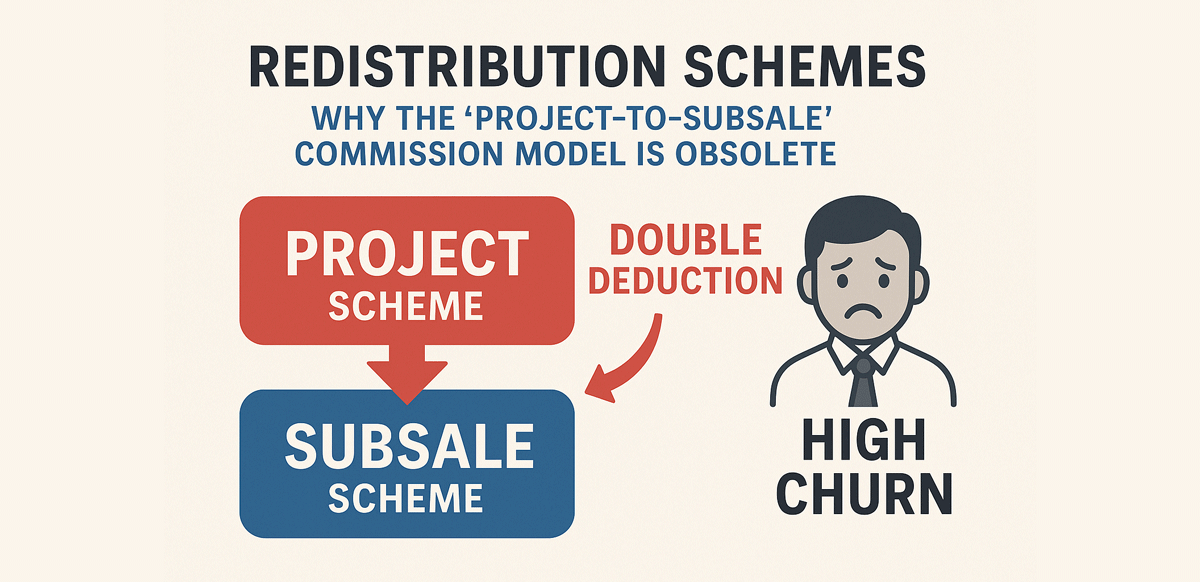
Old project-to-subsale redistribution models may not fit modern agency cooperation. Commission design should reflect actual roles, contribution, and business strategy.
A decade ago, Malaysia’s real estate agencies often used what was called a Redistribution Commission Scheme — a layered system where commissions from project sales were routed through the subsale structure again.
It started as a practical workaround, but it quickly became one of the biggest sources of agent dissatisfaction and, critically, high talent turnover.
When project teams were short-staffed, agencies would "borrow" negotiators from the subsale division to help close project units. While this filled a short-term manpower gap, it created a long-term fairness disaster.
Each project sale already carried a built-in company profit and commission structure. But when a subsale negotiator closed a project deal, their commission had to run through the subsale scheme again, triggering:
In effect, the closer’s portion was double-taxed—once under the project scheme and again under the subsale scheme.
This redistribution was originally justified because subsale leaders demanded recognition when their team members assisted project launches.
The redistribution model looked "fair" on paper—everyone got something—but it was administratively heavy and emotionally fragile. While it worked when agencies relied on manual accounting and goodwill, agencies eventually discovered its hidden cost: systemic agent churn.
Closing agents—the people who actually brought in the revenue—began leaving because they felt penalized for their success.
Here’s the breakdown of the failure:
Ultimately, the system collapsed under its own weight because it lost the confidence of the people doing the work.
Modern, competitive agencies have decisively shifted to designing commission schemes that are direct, transparent, and single-tier.
Each role—lister, closer, leader—gets credited once, not twice.
If collaboration happens across subsale and project divisions, it's handled through:
This shift isn't just about software—it’s about trust economics. When agents believe the system is transparent and fair, they stay longer, sell more, and attract better peers, creating a sustainable competitive advantage.
The redistribution model belonged to an era where manpower was borrowed and fairness was negotiated.
Today, in a high-churn, competitive industry, clarity beats complexity. Agents no longer tolerate being double-taxed for their success.
The message for agency bosses is simple: Reward the closer, respect contribution, and design your commission system to keep your best people—not push them to your competitors.

Founder of ListingMine and author of Agent for Life. Building ERP for Malaysian real estate agencies since 2008 — and writing to reshape how agencies grow.
More about Marvin Foong →More articles in this topic
This article is one of the sources behind this assessment. Take it to see what you already know and what to read next.
Educational self-assessment. Not a licensing examination or professional certification.