The industry often shifts risk to agents through commission-only income, weak training, and high dropout. Better structures are needed to stop treating agent failure as normal.
If most property agents were failing because they were lazy or incapable, the solution would be simple: better training, better motivation, better discipline. But that's not what we see. What we see is something far more consistent — and far more revealing.
In an industry where 8 to 9 out of 10 agents quit within two years, failure is not a coincidence. It is a pattern. And patterns at this scale are never caused by individuals. They are caused by design.
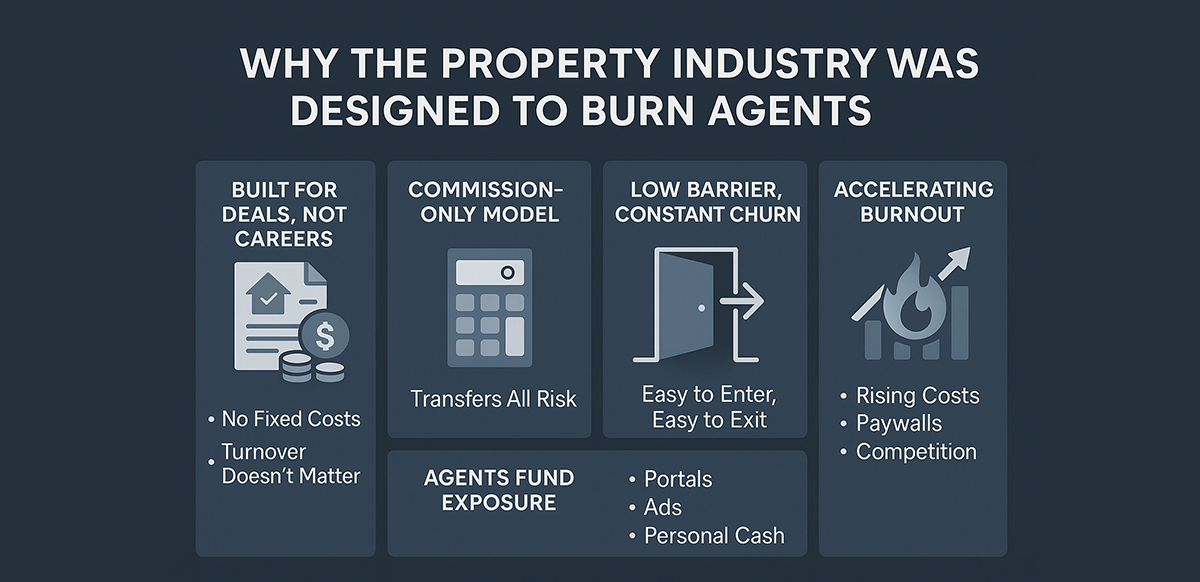
Malaysia's property agency model evolved around one objective: Close transactions with minimal fixed cost. From the system's point of view, agents are not employees to be carried. They are variables to be scaled.
The Agency's Math
The Result
If an agent succeeds, the agency wins. If an agent fails, the agency loses nothing. This is not negligence. It is architecture.
Commission-only compensation is often framed as fair: "You earn based on performance."
In reality, it does something very specific:
When 90% of agents fail, the system still works — because the system does not carry them. Commission-only didn't become standard because it was humane. It became standard because it was capital-efficient.
The two-day course. The SPM requirement. Fast REN registration. These are marketed as accessibility. Structurally, they serve another purpose:
Easy entry ensures optimism enters faster than burnout exits. The industry does not collapse under attrition. It runs on it.
Property portals and digital advertising did not just "appear." They solved a core industry problem:
How do we generate demand without carrying marketing risk?
Answer: Make agents pay for their own exposure. By externalising marketing costs:
Survival became a function of burn rate, not competence. This is not meritocracy. It is a cash endurance test.
In most industries, losing 80–90% of workers would trigger reform. In real estate, it is normalised. Why?
Because failure is individualised:
Systemic design is never questioned. As long as:
The system considers itself healthy.
Those who survive are held up as proof: "If they made it, anyone can."
What this ignores:
Survivors are not evidence the system works. They are evidence of what it demands.
This model worked — barely — in the past because:
But the most important shift is this:
In the past, effort equaled exposure. Today, money equals exposure.
Previously:
Time and effort could substitute for cash. Today:
The hustle has been replaced by a paywall. Low barriers to entry now hide a brutal truth: You can enter the industry cheaply, but you cannot operate cheaply. The entry door is open. The oxygen is not. That is why failure accelerates — not stabilises.
This industry doesn't need tougher agents. It needs a different structure. One that:
The property industry was designed to burn agents. If we want different outcomes, we need a different design.

Founder of ListingMine and author of Agent for Life. Building ERP for Malaysian real estate agencies since 2008 — and writing to reshape how agencies grow.
More about Marvin Foong →More articles in this topic