Overly visible boss luxury can create resentment when agents feel underpaid, unsupported, or exploited. Success branding must be balanced with team psychology.
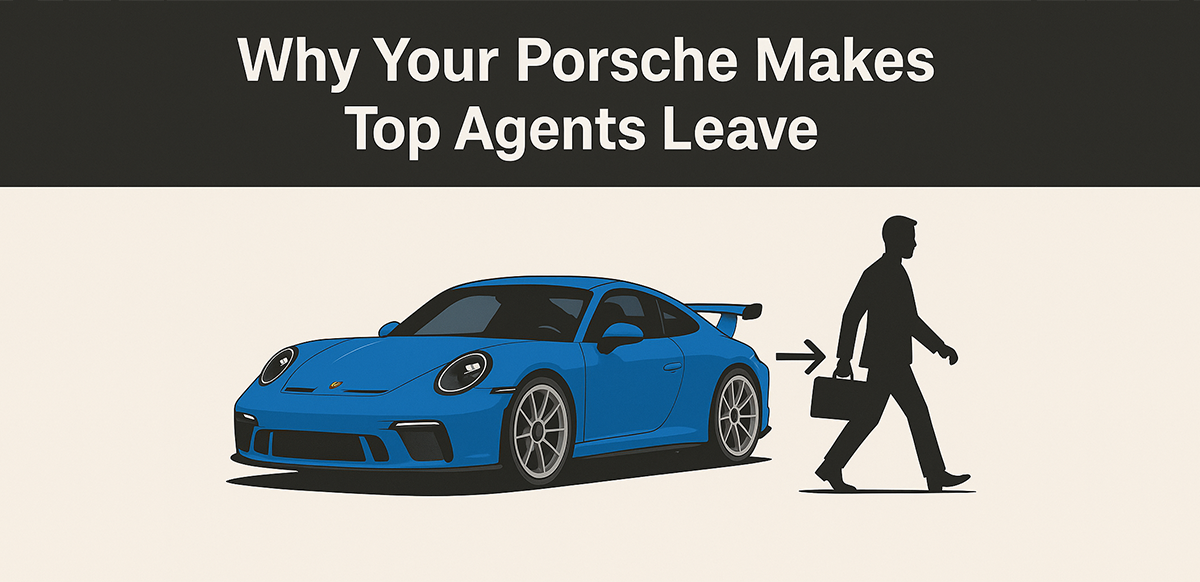
Your Car Is Not a Vehicle — It's a Balance Sheet.
When you are a Team Leader, your agents are not admiring your car. They are auditing it.
Experienced agents don't see leather, carbon fibre, or horsepower. They see overrides, cost structures, and leakage. If the math does not work in their favour, they don't complain. They leave.
A Porsche 911 GT3 is an effective recruitment tool — for rookies. New agents see:
But top performers read a completely different signal. They know exactly how much override you take, how thin their real margins are, and how hard consistent production actually is.
So when a senior agent sees a RM1m+ discretionary car, the subconscious question is not: "How can I become him?" It is:
"How much of my output is funding that?"
At that moment, the relationship shifts from partnership to economic friction. Once that happens, retention is already failing — even if no one says a word.
There is no moral answer here — only strategic clarity.
Option A: Recruitment Acceleration (Supercar Strategy)
Car: Porsche 911 GT3 / Ferrari / Lamborghini
Signal: "The ceiling is extremely high."
Outcome: Fast recruitment, strong aspiration, constant inflow.
Cost: Heightened scrutiny from top performers, override resentment, high senior churn.
This strategy is not wrong — but it is structurally unstable unless churn is part of your model.
Option B: Scale and Retention (MPV Strategy)
Car: Alphard / Vellfire (high-spec)
Signal: "This is an organisation, not a personality."
An MPV does something subtle but powerful:
Top performers don't feel pressure to escape. They feel the system can compound.
Some of the most effective leaders deliberately under-signal. A leader earning seven figures but driving a used executive sedan sends one clear message:
"The money stays in the system."
This creates moral authority, trust leverage, and long-term stability. It is not humility. It is control.
Even the Alphard has limits. What reassures agents can intimidate clients.
To your team, an Alphard is logistics. To a client, it is "Big Boss energy."
If your client drives a CR-V and you arrive in a Vellfire Executive Lounge:
Clients close deals when they feel like principals — not spectators.
One car cannot serve all objectives. High-functioning leaders separate signalling by role, not ego.
Car 1: For the Team
Vehicle: Alphard / Vellfire
Purpose: Stability, scale, leadership presence
Car 2: For Clients
Vehicle: Camry / Accord
Purpose: Neutrality, trust, deal execution
This is not extravagance. It is signal discipline.
There is one scenario where the GT3 strategy is valid. When you are already inside a true Ultra-High-Net-Worth (UHNW) circle.
If your clients drive Bugattis and Cullinans, a GT3 does not signal arrogance. It signals membership.
In this environment:
But this is the danger zone. Most agents think they are in this category. Almost none are. Serving rich people is not the same as being rich with them.
Unless you genuinely dine, invest, holiday, and lose money together, the supercar is a liability — not an asset.
Top agents stay when: Their income grows faster than leadership consumption, and the system feels fair.
Clients buy when: They feel respected, in control, and not out-ranked.
So drive deliberately. Alphard for your people. Camry for your deals. GT3 only if you are already in the club. Everything else is a strategy — or a cost — depending on whether you understand what it signals.

Founder of ListingMine and author of Agent for Life. Building ERP for Malaysian real estate agencies since 2008 — and writing to reshape how agencies grow.
More about Marvin Foong →More articles in this topic